
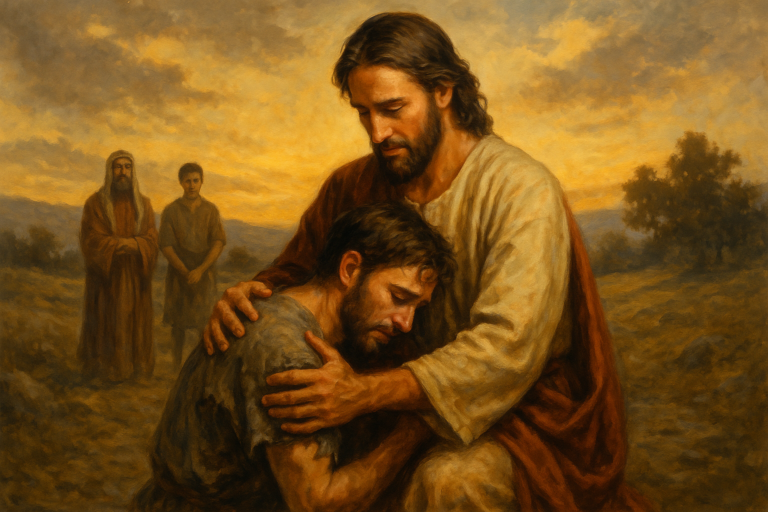
Early Christians Preached Repentance and Faith Validated by Deeds
The narrow path into the Kingdom of God is this truth of repentance from sin, which is shown and evidenced by deeds and not just words. The word of God says that we are to be doers of the word, not merely hearers of the word who deceive themselves into believing that it is acceptable to God. It is not, but many are deluded into believing that hearing the Word of God and not doing it is acceptable to God.
“Let the wicked forsake his way, And the unrighteous man his thoughts; Let him return to the LORD, And He will have mercy on him; And to our God, For He will abundantly pardon”. Isaiah 55:7
Many evangelicals today deny the role of repentance from sin in the message of salvation. In this article, we will look at several “early church leaders/fathers” and what they believed about the subject of repentance. Was repentance merely a change of mind? Or was it repentance from our sins against God? Or was the subject of repentance of no consequence and importance? (On page 5, a list of these early Christian leaders is provided).
“Noah preached repentance, and as many obeyed and got in the ark, they were saved. Jonah proclaimed destruction to the Ninevites, but they, repenting of their sins, made atonement to God by prayer and obtained salvation from destruction. However, they were aliens [to the covenant] of God. The ministers of the grace of God have, by the Holy Spirit, spoken of repentance.
And in another place God speaks thus: “Wash you, and become clean; put away the wickedness of your souls from before mine eyes; cease from your evil ways, and learn to do well; seek out judgment, deliver the oppressed, judge the fatherless, and see that justice is done to the widow; and come, and let us reason together. He declares, Though your sins be like crimson, I will make them white as snow; though they be like scarlet, I will whiten them like wool. And if you be willing and obey Me, you shall eat the good of the land; but if you refuse, and will not hearken unto Me, the sword shall devour you, for the mouth of the Lord has spoken these things.” Isaiah 1:16-20. Desiring, therefore, that all His beloved should be partakers of repentance, He has, by His almighty will, established [these declarations]. Clement of Rome (A.D. 96) ch.7-8. Is it not abundantly clear that the author taught repentance from sin, not in sin?
“While we are on earth, then, let us repent: for we are clay under the craftsman’s hand. For in like manner as the potter, if he be making a vessel, and it get twisted or crushed in his hands, reshapes it again; but if he have once put it into the fiery oven, he shall no longer mend it: so also let us, while we are in this world, repent with our whole heart of the evil things which we have done in the flesh, that we may be saved by the Lord, while we have yet time for repentance. For after that we have departed out of the world, we can no more make confession there, or repent any more. Second Clement (A.D. 100) ch.8. Again, it is abundantly clear that this church leader believed the truth about repentance being a turning away from evil we have done and stopping it.
“While we have time to be healed, let us place ourselves in the hands of God the physician, giving Him a recompense. What recompense? Repentance from a sincere heart.” Second Clement (A.D. 100) ch.9
“Therefore, brethren, let us repent forthwith. Let us be sober unto that which is good: for we are full of much folly and wickedness. Let us wipe away from us our former sins, and let us repent with our whole soul and be saved. And let us not be found men-pleasers”. Second Clement (A.D. 100) ch.13
“Therefore, brethren, since we have found no small opportunity for repentance, seeing that we have time, let us turn again unto God that called us, while we have still One that receives us. For if we bid farewell to these enjoyments and conquer our soul in refusing to fulfill its evil lusts, we shall be partakers of the mercy of Jesus”. Second Clement (A.D. 100) ch.16
“I read to you an exhortation to the end that you may give heed to the things which are written, so that you may save both yourselves and him that reads in the midst of you. For I ask of you as a reward that you repent with your whole heart, and give salvation and life to yourselves”. Second Clement (A.D. 100) ch.19
“Only pray you for them (the Heretics), if haply they may repent. This indeed is difficult, but Jesus Christ, our true life, has power over it”. Ignatius: to the Smyrnaeans (A.D. 35-105) ch.4
“Yea, and to all the saints that have sinned unto this day, if they repent with their whole heart, and remove double-mindedness from their heart. For the Master swore by His own glory, as concerning His elect; that if, now that this day has been set as a limit, sin shall hereafter be committed, they shall not find salvation; for repentance for the righteous has an end; the days of repentance are accomplished for all the saints; whereas for the Gentiles there is repentance until the last day”. Hermas (A.D. 150) ch.11. This word is very powerful and would be rejected in most evangelical churches in the United States, I believe.
“They then that shall repent, if they repent, will be strong in the faith, if they repent now while the tower is building. But if the building shall be finished, they have no more any place, but shall be castaways”. Hermas (A.D. 150) Ante-Nicene Fathers vol.1 pg. 14
“To repent is great understanding,” said he. “For the man that has sinned understands that he has done evil before the Lord, and the deed which he has done enters into his heart, and he repents, and does no more evil, but does good lavishly, and humbles his own soul and puts it to torture because it sinned. You see then that repentance is great understanding.” Hermas (A.D. 150) Ante-Nicene Fathers vol.1 pg.22. What a great word from Hermas. Well said.
“But I say unto you,” said he, “if after this great and holy calling anyone, being tempted of the devil, shall commit sin, he has only one (opportunity of) repentance. But if he sin, off-hand, and repent, repentance is unprofitable for such a man; for he shall live with difficulty.” Hermas (A.D. 150) Ante-Nicene Fathers vol.1 pg.22. A strong word that many weak men will faint at.
“You then that repent, cast away the evil doings of this world which crush you; and, by putting on every excellence of righteousness, you shall be able to observe these commandments, and to add no more to your sins. If then you add no further sin at all, you will depart from your former sins”. Hermas (A.D. 150) Ante-Nicene Fathers vol.1 pg. 36. Another great word and something to aspire to. How feeble and weak must our idea of Christianity look to these men and women.
“Well, do you think that the sins of those who repent are forgiven immediately? Certainly not; but the person who repents must torture his own soul, and must be thoroughly humble in his every action, and be afflicted with all the divers kinds of affliction; and if he endure the afflictions which come upon him, assuredly He who created all things and endowed them with power will be moved with compassion and will bestow some remedy”. Hermas (A.D. 150) Ante-Nicene Fathers vol.1 pg.38. This word sounds almost cruel to our soft western minds, does it not? How many Christians today have such a powerful fear of sin? To many Christians, it seems that sin is not that big a deal.
“…the Lord, how great and glorious it is, and He has given (His) Spirit to those that are worthy of repentance.” “Wherefore then, Sir,” say I, “did they not all repent?” “To those, whose heart He saw about to become pure and to serve Him with all the heart, to them He gave repentance; but those whose craftiness and wickedness He saw, who intend to repent in hypocrisy, to them He gave not repentance, lest haply they should again profane His name.” Hermas (A.D. 150) Ante-Nicene Fathers vol.1 pg. 41. Some Christian denominations have developed a form of repentance that lacks genuine repentance.
“Go, and tell all men to repent, and they shall live unto God; for the Lord in His compassion sent me to give repentance to all, though some of them, because of their deeds do not deserve to be saved”. Hermas (A.D. 150) Ante-Nicene Fathers vol.1 pg. 42.
“As many,” [said he,] “as [shall repent] from their whole heart [and] shall cleanse themselves from all the evil deeds aforementioned, and shall add nothing further to their sins, shall receive healing from the Lord for their former sins, unless they be double-minded concerning these commandments, and they shall live unto God.” Hermas (A.D. 150) Ante-Nicene Fathers vol.1 pg.42. Another very powerful word on repentance from sin.
“These are they that have heard my commandments now, and have practiced repentance with their whole heart. So when the Lord saw that their repentance was good and pure, and that they could continue therein, he ordered their former sins to be blotted out”. Hermas (A.D. 150) Ante-Nicene Fathers vol.1 pg. 54. When was the last time you heard an evangelical pastor say anything close to this?
“And the Lord, knowing the heart, and foreknowing the future, foresaw both the fickleness of man and the craft and subtlety of the devil from the first, from the beginning; how that, envying man for the forgiveness of sins, he would present to the servants of God certain causes of sins; skillfully working mischief, that they might fall together with himself. Accordingly, being very merciful, He has vouch-safed, in the case of those who, though in faith, fall into any transgression, a second repentance; so that should anyone be tempted after his calling, overcome by force and fraud, he may receive still a repentance not to be repented of. “For if we sin willfully after that we have received the knowledge of the truth, there remains no more sacrifice for sins, but a certain fearful looking for of judgment and fiery indignation, which shah devour the adversaries.” (Hebrews 10) But continual and successive repenting for sins differ nothing from the case of those who have not believed at all, except only in their consciousness that they do sin. Clement of Alexandria (A.D. 195) Ante-Nicene Fathers vol.2 pg.360. I well remember my attitude as a young Roman Catholic, who thought little about confessing the same sins over and over again. Where was the repentance in any of it? Confessing but not actually forsaking sin is a great deception, and some denominations specialize in this fraudulent type of repentance.
“Born again, not of blood, nor of the will of the flesh,” but in the Spirit; which consists in repenting by not giving way to the same fault. For frequent repentance and readiness to change easily from want of training, is the practice of sin again. The frequent asking of forgiveness, then, for those things in which we often transgress, is the semblance of repentance, not repentance itself. Clement of Alexandria (A.D. 195) Ante-Nicene Fathers vol.2 pg.361. Another great word about repentance, without repentance, that is so popular even today. See my article on Repentance without Repentance.
“Repentance then becomes capable of wiping out every sin, when on the occurrence of the soul’s fault it admits no delay, and does not let the impulse pass on to a long space of time. For it is in this way that evil will be unable to leave a trace in us, being plucked away at the moment of its assault like a newly planted plant. Clement of Alexandria (A.D. 195) Ante-Nicene Fathers vol.2 pg.580. What would happen if this word was preached in your typical evangelical church?
“Forgiveness of past sins, then, God gives; but of future, each one gives to himself. And this is to repent, to condemn the past deeds, and beg oblivion of them from the Father, who only of all is able to undo what is done, by mercy proceeding from Him, and to blot out former sins by the dew of the Spirit. “For by the state in which I find you will I judge,” Clement of Alexandria (A.D. 195) Ante-Nicene Fathers vol.2 pg.602. Yet, how many evangelicals tell us the God forgives past, present and future sins before we even commit them?
“These things, beloved, we write unto you, not merely to admonish you of your duty, but also to remind ourselves. For we are struggling on the same arena, and the same conflict is assigned to both of us. Wherefore let us give up vain and fruitless cares, and approach to the glorious and venerable rule of our holy calling. Let us attend to what is good, pleasing, and acceptable in the sight of Him who formed us. Let us look steadfastly to the blood of Christ, and see how precious that blood is to God, (1) which, having been shed for our salvation, has set the grace of repentance before the whole world. Let us turn to every age that has passed, and learn that, from generation to generation, the Lord has granted a place of repentance to all such as would be converted unto Him. Noah preached repentance, and as many as listened to him were saved. (2) Jonah proclaimed destruction to the Ninevites; (3) but they, repenting of their sins, propitiated God by prayer, and obtained salvation, although they were aliens [to the covenant] of God. The ministers of the grace of God have, by the Holy Spirit, spoken of repentance; and the Lord of all things has himself declared with an oath regarding it, “As I live, saith the Lord, I desire not the death of the sinner, but rather his repentance; “(4) adding, moreover, this gracious declaration Repent O house of Israel, of your iniquity. (5) Say to the children of My people, Though, your sins reach from earth to heaven, I and though they be redder (6) than scarlet, and blacker than sackcloth, yet if ye turn to Me with your whole heart, and say, Father! I will listen to you, as to a holy (7) people.” And in another place, He speaks thus: “Wash you, and become clean; put away the wickedness of your souls from before mine eyes; cease from your evil ways, and learn to do well; seek out judgment, deliver the oppressed, judge the fatherless, and see that justice is done to the widow; and come, and let us reason together. He declares, “Though your sins be like crimson, I will make them white as snow; though they be like scarlet, I will whiten them like wool. And if ye be willing and obey Me, ye shall eat the good of the land; but if ye refuse, and will not hearken unto Me, the sword shall devour you, for the mouth of the Lord hath spoken these things.” (8) Desiring, therefore, that all His beloved should be partakers of repentance, He has, by His almighty will, established [these declarations]”. I took all of these quotes from Mike’s website.
If you are interested in more quotes and what the early church fathers taught about such things as repentance, there are many searches available to you to help in the endeavor. Using ChatGPT, I retrieved the following to the question, “What did the early church fathers teach about repentance?” This is the result.
“The early church fathers placed a high emphasis on repentance from sin as essential to salvation and or maintaining a relationship with God”. The search listed:
- Clement of Rome 1st century;
- Ignatius of Antioch, early 2nd century – he taught a radical transformation of life;
- Justin Martyr mid mid-2nd century – he taught that repentance involved abandoning sinful behaviors and adopting Christian virtues;
- Irenaeus of the late 2nd century – he taught and emphasized the freedom of the will we have to repent and cooperate with God’s grace. He also taught the restoration of the image of God in man with repentance. Christ enables our repentance;
- Tertullian, early 3rd century – he has a strong view of post-baptismal repentance. – He opposed casual attitudes toward sin and believed true repentance required sincere mourning and public confession;
- Origen, early 3rd century – he describes repentance as a lifelong process, not just a one-time event. Repentance is essential for purification and union with God, according to Origen.
You will notice that Augustine is not included in this list. Augustine is a 5th-century church leader.
In summary, the early church fathers believed the following.
- Repentance from sin is essential for forgiveness and salvation.
- Repentance involves a change of heart, mind, and behavior.
- It is not a one-time event but an ongoing practice in a Christian’s life.
- Repentance must be accompanied by visible fruit such as good works, confession, and humility.
- Repentance was not only possible, it was demanded.
It will also provide you with specific quotes about repentance from all the earliest church fathers if you request them—great news for research.
What is the Biblical meaning of the word repent? ChatGPT responds with: the Hebrew word is “shuv,” and the meaning is “to turn back, return, or go back.” Examples can be found in Joel 2:12 and Ezekiel 18:21, where the meaning is to change direction, as in a return to covenant faithfulness and a right relationship with God. In Greek, the word is metanoeo, and it means to change one’s mind, think differently, or reconsider. It implies a profound inner transformation, “often followed by a change in behavior”. This word means much more than regret. It means a complete orientation of life towards God, involving both our thoughts and our actions.
In summary, repentance is not just feeling sorry for our sin; it means:
- Turning away from sin and stopping it
- Turning toward God, in faith
- Changing the mind and heart
- Demonstrating this change in new righteous behavior.
Repentance is a decisive and ongoing response to God’s call to holiness of heart, action, and behavior, as understood by these early church leaders. Does that sound like anything being taught in the evangelical church today?
