
July 5, 2024
“This is the bread which cometh down from heaven, that a man may eat thereof, and not die. I am the living bread which came down from heaven: if any man eat of this bread, he shall live forever: and the bread that I will give is my flesh, which I will give for the life of the world. The Jews therefore strove among themselves, saying, How can this man give us his flesh to eat? Then Jesus said unto them, Verily, verily, I say unto you, Except ye eat the flesh of the Son of man, and drink his blood, ye have no life in you. Whoso eateth my flesh, and drinketh my blood, hath eternal life; and I will raise him up at the last day. For my flesh is meat indeed, and my blood is drink indeed. He that eateth my flesh and drinketh my blood, dwelleth in me, and I in him. As the living Father hath sent me, and I live by the Father: so he that eateth me, even he shall live by me. This is the bread which came down from heaven: not as your fathers did eat manna, and are dead: he that eateth of this bread shall live forever.” John 6:50-58 KJV.
Jesus said that He is the bread of life in verse 48, who came down from heaven. He did not promise His apostles that they would not die physically if they ate His physical body and drank His literal blood. In any case, how could they eat His body and drink His blood literally while He sat at the table with them? He obviously did not cut off His flesh for them to eat. Nor did He drain His blood for them to drink. By the Mosaic Law, no Jew would ever drink the blood of animals, let alone a human being, which was strictly forbidden. This was clearly symbolic. His flesh and blood represented something of critical eternal importance.
Jesus died physically, and so did all the apostles, years later. The promise that those who eat the bread and drink the wine was a spiritual promise regarding eternal life with and in Christ. It had nothing to do with physical life and physical death. Physical bread and wine pointed to something of infinite importance.
“And when he had given thanks, he brake it, and said, Take eat: this is my body, which is broken for you: this do in remembrance of me. After the same manner also he took the cup, when he had supped, saying, this cup is the New Testament in my blood: this do ye, as oft as ye drink it, in remembrance of me. For as often as ye eat this bread, and drink this cup, ye do shew, the Lord’s death till he come.” I Corinthians 11:24-26
In Corinth, a warning was given because some people gathered together, and divisions arose; some were fed, while others were not, and some became drunk. The warning was to make sure they didn’t abuse this sacred time of remembrance. In verse 27, it states that whoever “shall eat of this bread and drink of this cup of the Lord unworthily, shall be guilty of the body and blood of the Lord”. Examine yourself first.
The consequences for despising the Lord in this way are frightening. “For he that eateth and drinketh unworthily, eateth and drinketh damnation to himself, not discerning the Lord’s body. For this cause many are weak and sickly among you, and many sleep” verse 31. Those who teach a carnal brand of Christianity love to use this verse as evidence that Christians who sin too much may get killed, “many are weak and sickly among you, and many sleep,” and taken to heaven. But the word says that those who sin in this manner bring “damnation” to themselves, not just sickness or physical death.
If you are still unsure about the meaning of this, let us consider what the Apostle Paul wrote in chapter 10 of the same book. This sets the stage for a proper interpretation of Chapter 11.
“And were all baptized unto Moses in the cloud and in the sea; And did eat the same spiritual meat; And did all drink the same spiritual drink; for they drank of that spiritual Rock that followed them: and that Rock was Christ.” 1 Corinthians 10:2-4
Eating and drinking were clearly used as a figure of speech to convey that spiritual meat and drink (believing the truth) have nothing to do with physical and literal meat and drink.
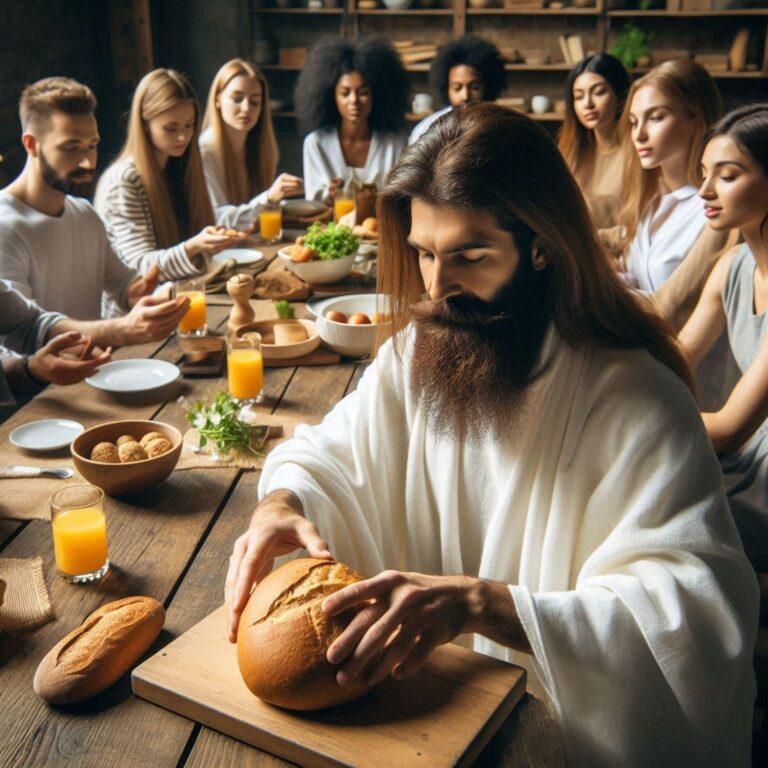
Believers gathered together for a complete meal (not a tiny piece of flat sun-shaped bread and a sip of juice) to remember the LORD Jesus Christ and the price He paid for their salvation. He shed His blood for the remission of our sins, not His sins. He is without sin.
Why is this practice so important to Christians?
The easy answer is that Jesus told us to do it when a group of believers gathered together. He did not specify how often or when to do it. Jesus did it once on His last Passover meal with the apostles. There was only one ‘last supper’. That does not mean we should only do it once a year, but it also doesn’t mean it should be done every time Christians meet together.
Early on, this practice gained traction. Christian groups have been doing this from the beginning. It did not take long for it to be corrupted by humans within the emerging Roman Catholic Church.
Are we supposed to interpret this literally or symbolically?
The Roman Catholic Church has decided to interpret this literally. They actually pretend to believe that the physical bread and wine turn into the literal body and blood of Jesus Christ. It is called transubstantiation. The bread and wine do not literally change, and both the substance and the appearance remain the same. However, they actually force themselves to believe that the substance does literally change, even though it doesn’t. Go figure. Is this not an example of superstition and religion being blended together? Other Christians believe something similar, but don’t go as far as the Roman Catholic Church does. Over the centuries, Bible believing Christians who refused to accept this absurdity were often tortured and murdered by the Roman Catholic Church.
What does it mean?
Elsewhere, Jesus told His followers to abide in Him and keep His teachings and commandments. Eating His flesh and drinking His blood means that we make Him the LORD and Savior of our lives. We seek to walk, act, and talk like Jesus, and in that way, we eat His flesh and drink His blood spiritually.
In the book of Exodus, God commanded Moses, Aaron, Nadab, Abihu, and seventy of the elders to come up to Him on the mountain. They were not to get too close, but to worship from afar off. Only Moses was to get close to God. Before this, they offered sacrifices of blood to the Lord. Without the shedding of blood is there is no remission of sins. Then they went up on the mountain and they saw the God of Israel. Under His feet, a paved work of a sapphire stone, and as it were, the body of heaven in His clearness, verse 10.
“And upon the nobles of the children of Israel he laid not his hand: also, they saw God and did eat and drink.” Exodus 24:11, emphasis added.
God favored them with His divine presence, which was very unusual and a great kindness from God. God showed Moses His glory, but he only got to see God’s backside. All these men got to see God in His glory, and they did eat and drink. A few commentators that I respect state that this group ate a meal together, and that is all this phrase, “they did eat and drink”, means. But could this story have a deeper meaning?
Scripture tells us, “They saw God and then did eat and drink”. Might this mean that they internalized the splendor and majesty of the living God in all His glory (figuratively, they ate and drank God)? Think about this story for a moment. We are told that they saw God in His glory and then “they did eat and drink”. Can you imagine encountering God Almighty and then wanting to eat and drink? I find that very hard to swallow! When I have times when the presence of God is very near, I never once thought about having something to eat during or immediately afterward. I continued to feast on the nearness of the Lord. Food was not on my mind, nor do I think it was on their mind. They “did eat and drink God” and were full.
Think of the time when Jesus witnessed to the Samaritan woman in John 4:32, while His disciples went to get something for them to eat. They returned to Jacob’s well and expected Jesus to eat. But Jesus said that He was not hungry, and that He had food to eat that they were unaware of. His food was to do the will of the Father, and with that, He was satisfied, and food did not appeal to Him at that moment.
If all this is true, it makes the Last Supper (Communion) more compelling and understandable. If this event in Exodus foreshadows the last supper, then what does it mean?
At the last supper, Jesus said to His disciples, Unless you eat my flesh and drink my blood, you have no part with me. To eat the flesh and drink the blood of Jesus Christ is to swallow or internalize the truth of God into all that we think and do. If we are what we eat, then to eat Jesus and drink His blood is to become like Him, not in substance, but in character. We become partakers of the divine nature, as stated in 2 Peter 1:4. Jesus said, “If you abide in My word, you are truly My disciples.” Elsewhere, we are told to abide and continue in Christ, for apart from Him, we can do nothing. Abiding in Christ is to eat His flesh and drink His blood, not physically but spiritually and morally. The new birth is not physical but a spiritual and moral rebirth. It is “eating the flesh and drinking the blood” of the Messiah.
Communion is the commemoration of what Jesus Christ did for us by His suffering and death on the cross, for our many sins, that we might be reconciled to God. The atonement of Jesus made regeneration possible. It is sacred and must be treated as such.
Because many of us have been brought up seeking ‘form over substance,’ we often miss the more profound truths of Scripture. The formalism of Churches regarding communion can be inspiring at a superficial level. And the temporal inspiration quickly vanishes. The truth is inspiring at a much deeper level and changes who we are at the core. It is not about a ritual that doesn’t change our hearts.
And they saw God and ‘did eat and drink’. Jesus said that He is living water and that those who drink of the water He shall give them (the truth), shall never thirst again. How true that is. Praise God.
“And were all baptized unto Moses in the cloud and the sea; And did eat the same spiritual meat; And did all drink the same spiritual drink; for they drank of that spiritual Rock that followed them: and that Rock was Christ.” 1 Corinthians 10:2-4
