

March 13, 2026
I find it truly amazing and incredibly disappointing that evangelical theologians and pastors often look to this passage as a proof text supporting the unbiblical belief in the doctrine of eternal security. Some of the most well-known Christian leaders have done so. (See the appendix for a listing of names and quotes.)
A person does not need to be a Bible scholar to know that 1 John states that there is no such thing as unconditional eternal security; it teaches the exact opposite: conditional security. The text itself proves this beyond a shadow of a doubt. We will look into this carefully, and you can make up your own mind.
Text of 1 John 5:13
“These things have I written unto you that ye may know that ye have eternal life, and that ye may believe on the name of the Son of God.” 1 John 5:13, KJV
Key points in the wording:
- “Ye may know” – John emphasizes assurance, not necessarily automatic, unconditional, guaranteed eternal security.
- “Have eternal life” – Present tense language indicates ongoing life, not a one-time possession.
- “These things have I written” – The context is the entire letter, which repeatedly warns about sin, false teachers, and falling away. If these are not warnings, then what are they? Every attempt to denude the warnings is an attempt to hide the plain truth. This passage does not offer assurance of unconditional salvation, as many would have us believe.
Support for using this verse for eternal security
Some modern evangelicals interpret this verse as saying:
- Once saved, always saved – The verse explicitly states, “you have eternal life,” so if you truly possess it, you cannot lose it.
- Assurance of salvation – John wrote it so believers can know their eternal destiny, implying certainty.
- Faith in Christ guarantees salvation – The verse links knowledge of life to believing in Jesus’ name; once that faith exists, salvation is “locked in.”
Many KJV-only or Reformed-leaning groups quote it as proof-text: “See? John says you have eternal life. End of story.”
Arguments against using it for eternal security
However, if we read 1 John in context, the picture is more nuanced:
a) 1 John emphasizes obedience and perseverance
- John repeatedly says that abiding in Christ matters:
- 1 John 2:3-6. “Hereby we do know that we know Him, if we keep His commandments.”
- 1 John 3:6. “Whosoever abideth in Him sinneth not.”
- Eternal life is consistently tied to meeting the conditions, such as living and walking in God’s truth and love, not merely a one-time belief in the past.
b) Warnings against falling away
- 1 John warns about antichrists and those who deny Christ (1 John 2:18-19; 2:22-23).
- These passages imply that a person who truly rejects God’s commandments or Jesus’ identity risks losing not just fellowship, but life itself.
c) Eternal life as present and conditional
- John sometimes presents eternal life as both a present reality and a future hope:
- 1 John 5:11-12: “And this is the record, that God hath given to us eternal life, and this life is in His Son. He that hath the Son hath life; he that hath not the Son hath not life.”
- Notice: the possession of the Son (i.e., continued faith and union with Christ) is key. Eternal life is not a static label; it is relational and is based on our meeting the conditions.
d) Assurance does not equal an automatic, guaranteed security, no matter how a person lives
- John’s point in 5:13 is more about encouraging believers to test themselves and have confidence, not teaching that salvation is irrevocable regardless of life choices. Continued sinfulness is evidence that a person is born of the devil and not God.
- Assurance comes from faith, obedience, and discernment of the Spirit, not a blanket unconditional guarantee, such as eternal security.
Scholarly and historical support
Against eternal security:
- Early church fathers (like Clement of Alexandria and John Chrysostom) warned against presuming salvation without ongoing holiness. And that is not a fictional imputed holiness but the real thing.
- Modern Orthodox and Arminian interpretations see this verse as a call to assurance through faith and obedience, not license for sin or a get-out-of-jail-free card, as many evangelicals believe.
For eternal security (evangelical perspective):
- Many Reformed commentators point to the present tense “have eternal life” as unlosable once genuinely possessed. That is like saying that once you are married, you are always married, even if you break your vows. We all know that is simply not true. Remember that God divorced unfaithful Israel. Eternal life is no different.
- John Piper, Wayne Grudem, and similar theologians sometimes use 5:13 to assure believers that faith in Christ guarantees eternal life, though most of them contextualize it with ongoing faith.
Summary comparison chart follows
| Aspect | Eternal Security Reading | Contextual/1 John Reading |
| Assurance | “You have it now, it can’t be lost.” | “You may know you have it if you remain in Christ.” |
| Relation to sin | Irrelevant; past faith guarantees life | Obedience and abiding are crucial (1:6, 3:6, 3:9) |
| Warnings | Ignored | Central: antichrists, falling away, sin as evidence of being outside God |
| Tense | Present = permanent possession | Present = relational experience dependent on faith and obedience |
Bottom line
- 1 John 5:13 does encourage believers to have assurance of their salvation, but the letter as a whole emphasizes that eternal life is relational and conditional, dependent on continued faith, obedience, and avoidance of false teaching.
- Using 5:13 to teach “once saved, always saved” strains John’s context, because the rest of the epistle consistently warns that those who sin and reject Christ risk eternal separation from God. Many of these warnings are extremely clear.
1 John 5:13 (KJV)
“These things have I written unto you that ye may know that ye have eternal life, and that ye may believe on the name of the Son of God.”
- Written for assurance, not a guarantee, irrespective of how you live.
- Present tense “have eternal life” could suggest possession.
- But it is conditional on believing and abiding in the Son. John is addressing believers in the context of the letter.
1 John 2:19 (KJV)
“They went out from us, but they were not of us; for if they had been of us, they would no doubt have continued with us: but they went out, that they might be made manifest that they were not all of us.”
Analysis:
- John explicitly warns that some who appear part of the church may fall away.
- Assurance of eternal life is not automatic; the truly faithful are recognized by continuing in fellowship with God and the community.
- Line-by-line comparison:
- 5:13 says, “You may know you have eternal life.”
- 2:19 says, “Not all who seem to belong actually will endure.”
- Implication: Knowledge in 5:13 is tested by ongoing faithfulness.
1 John 3:6 (KJV)
“Whosoever abideth in him sinneth not: whosoever sinneth hath not seen him, neither known him.”
Analysis:
- Eternal life is tied to and conditioned on abiding in Christ.
- The present participle “abideth” and “sinneth not” indicate a continuing lifestyle, not a one-time declaration, as those who believe in eternal security think and teach.
- Comparison to 5:13:
- 5:13 gives assurance.
- 3:6 conditions that ensure ongoing obedience.
- Implication: You cannot claim “eternal life” if you reject God’s ways. Assurance is relational, not legalistic.
1 John 3:9 (KJV)
“Whosoever is born of God doth not commit sin; for his seed remaineth in him: and he cannot sin, because he is born of God.”
Analysis:
- “Cannot sin” here is best understood as habitual or continued, unrepentant sin.
- John is drawing a line between genuine believers and those who appear to believe but persist in rebellion.
- Comparison:
- 5:13: “You may know you have eternal life.”
- 3:9: Only those truly born of God, whose life is transformed, can rightly claim eternal life.
- Implication: Assurance is evidence-based, not a blanket guarantee.
Synthesis is seen in the following chart
| Verse | Key Idea | Relation to 5:13 “Eternal Security” |
| 5:13 | Believers may know they have eternal life | Used by evangelicals to argue that once saved, always saved |
| 2:19 | Continuance in fellowship is proof of true belonging | Contradicts unconditional security |
| 3:6 | Abiding in Christ = not sinning | Shows eternal life is relational, ongoing |
| 3:9 | Born of God = transformed life, cannot live in persistent sin | Assurance tied to genuine new birth, not mere profession |
Conclusion:
- 1 John 5:13 does encourage believers to be confident, but the surrounding context in 1 John makes clear that eternal life is conditional on continued faith, obedience, and abiding in Christ.
- Using 5:13 as proof of “once saved, always saved” ignores the practical, moral, and relational tests John consistently lays out. It is a false doctrine founded on a false foundation.
- Eternal life is assured relationally, not automatically guaranteed, no matter how a Christian lives.
- Eternal Security invites believers to relax their guard against sin because it provides an excuse and cover for ongoing sinful conduct.
Step-by-Step Explanation
- Belief in Jesus (Faith)
- Base requirement: trusting the Son of God (1 John 5:13).
- This opens the relationship, but faith alone is not presented as a static, irreversible guarantee.
- Abiding in Christ / Union with Him
- Continuous relationship: 1 John 3:6 emphasizes that those who abide do not live in repeated sin.
- Abiding is active and relational, not just a one-time declaration.
- Living in Obedience / Avoiding Ongoing Sin
- John makes clear: persistent sin shows you do not truly know Christ (3:6, 3:9).
- Eternal life is tied to transformed behavior, not just intellectual assent.
- Assurance of Eternal Life
- 5:13 gives believers confidence, but that confidence is conditional: it depends on the steps above.
- Assurance is relational and moral: you know you have life because of faith and abiding, not because of a one-time act.
- Evidence: Continued Fellowship
- 2:19 shows that true believers continue with the community and God.
- Those who leave or reject Christ reveal they were never truly “born of God,” or that they are backslidden/apostate, reinforcing that eternal life is not automatic, not unconditional, and not guaranteed, no matter how a person lives
See the diagram that follows, produced by ChatGPT.
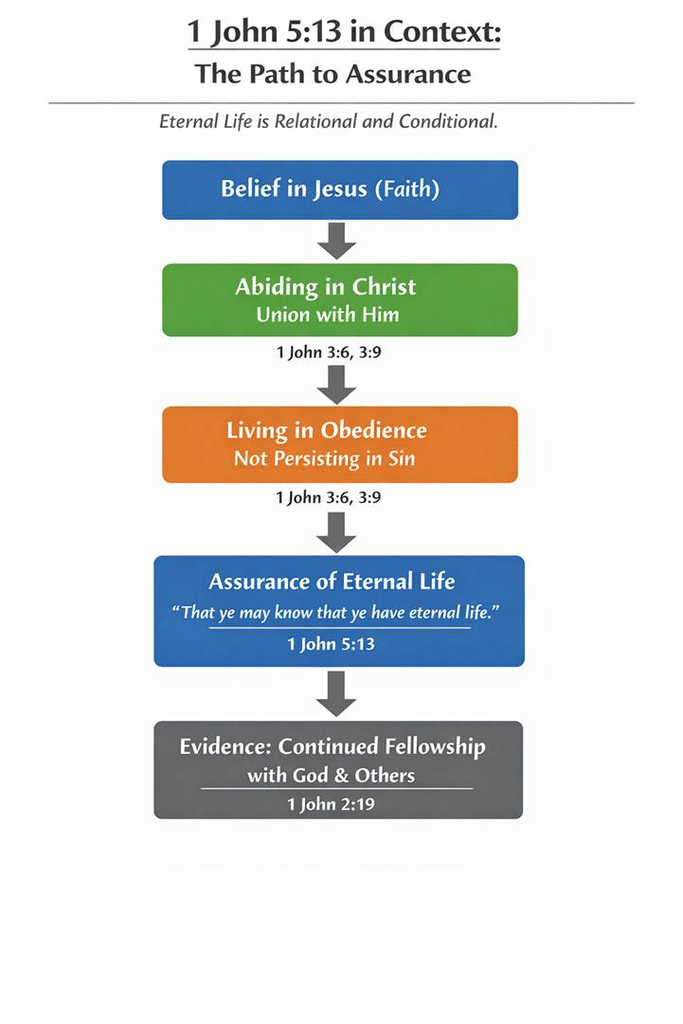
For pastors and theologians to teach that this passage supports eternal security and all that entails is truly a remarkable specimen of eisegesis. Again, I find it truly amazing and incredibly disappointing that evangelical theologians and pastors often look to this passage as a proof text supporting the unbiblical belief in the doctrine of eternal security.
As you will read in this short article, some of the most well-known Christian leaders have done so. (See the appendix for a listing of names and quotes.)
Your average Christian does not need to be a Bible scholar to know that the Book of 1 John states there is no such thing as unconditional eternal security, no matter how sinful they continue to be, but actually teaches the exact opposite: conditional security. The text itself proves this beyond a shadow of a doubt. We will look into this carefully, and you can make up your own mind. See my article on 1 John 1:5-10, If we say we have no sin…
In closing this epistle, John says the following.
“We know that whosoever is born of God sinneth not; but he that is begotten of God keepeth himself, and that wicked one toucheth him not.” 1 John 5:18.
Just in case you are thick-headed, incredibly deceived, and slow to understand, the apostle added this one last warning. No one who claims to be a born-again Christian and who continues to sin is born of God but of the devil. But the eternal security crowd teaches exactly the opposite of this truth. Calvinists and evangelicals who believe in eternal security also believe that real Christians sin every day or nearly so.
Notice also that John said, “he that is begotten of God keepeth himself.” To remain and abide in Christ, we must keep ourselves in the love of God, continue to abide in Jesus Christ, and not keep sinning. You might never have heard that before.
To many evangelicals, salvation is not such a radical change that it involves the complete renunciation of sin. They have been told that salvation is about believing and trusting that Christ has done it all. They may not even mention repentance from sin as a condition of justification. They are told that God will cleanse them of sin through sanctification throughout their lives. No wonder they remain passive, waiting on God to do what God demands of them.
And they are told that sin will always be in their lives until they die. Most of the evangelical church seems to believe that God alone keeps and cleanses. That is not what this passage states: “he that is begotten of God keepeth himself.” If you are born of God, you keep yourself in God by meeting the conditions. God’s grace helps us when we need it. Most evangelicals have been told that God is responsible for cleaning them up, and that never actually happens because God is waiting on them to do the keeping and forsaking of sin.
Appendix prepared by ChatGPT
Here are concrete examples of evangelical/Reformed leaders and teachers who have explicitly (or in practice) used 1 John 5:13 and related assurance language to support some form of eternal security/perseverance of the saints (often tied to Calvinistic theology). I’ll include who they are, how they use the text, and the context around their view:
✅ 1. Wayne Grudem (Reformed Evangelical Theologian)
Who he is:
Prominent evangelical theologian, author of Systematic Theology, and widely taught on the Perseverance of the Saints.
How he relates to eternal security:
- Grudem defines perseverance of the saints as the teaching that true believers will be kept by God and persevere until the end.
- Many in Reformed and evangelical circles treat 1 John 5:13 as part of the biblical promise that believers can be assured they have eternal life now because Christ secures and preserves them. This assurance is often paired with perseverance theology. For example, sermons on the passage sometimes highlight that believers may know they have eternal life “secure in Christ”—a confidence tied to persevering faith rather than a mere one-time decision.
Note: Grudem’s own formulation emphasizes evidence of genuine conversion (perseverance) as the basis for assurance, not a divorced “once saved, always saved” that ignores ongoing faithfulness.
My response follows.
But what, pray tell, is the evidence of genuine conversion? Could it be a holy life? Yes, if you believe the Calvinistic nonsense that a person can be holy and unholy at the exact same time. For the full Calvinists and most evangelicals, every believer sins daily in thought, word, and deed. Is daily sin evidence of genuine conversion, or evidence of being a reprobate, too?
✅ 2. John Piper (Reformed Pastor and Theologian)
Who he is:
Founder and teacher at Desiring God, long-time pastor at Bethlehem Baptist Church, a major voice in Reformed evangelicalism.
How he relates to eternal security:
- Piper teaches the Perseverance of the Saints—that those truly justified will be kept by God’s power to the end. This is a standard Calvinistic framing of security.
My response follows.
But what does that actually mean? The justified will be kept by God’s power to the end. If the power of God is unable to get us to stop sinning daily, how can we believe the power of God is able to save us while we continue to sin daily? This makes no sense at all.
- On his site and in devotionals, Piper affirms that believers can have assurance of salvation, rooted in God’s keeping power (e.g., “they will never perish” from John 10:28-29). Although discussions don’t always focus directly on 1 John 5:13, many Reformed teachers (including Piper) use this text in broader discussions of assurance to show that believers can know they have eternal life.
My response follows.
I agree that genuine believers can know they have eternal life. How? Because they are conscious that they abide in Christ and have actually repented of their sins. Sin is the rare exception in life, not a daily habit, as most Calvinists and evangelicals believe. That is how they have assurance.
For the sin-daily crowd, they must force themselves to believe a lie that sinning Christians are eternally secure. Their actual lives will not give them the assurance they desperately seek. That assurance only comes to those who meet the conditions of salvation.
ChatGPT adds this important nuance: In Piper’s teaching, assurance isn’t automatic at conversion alone; it is grounded in God’s preservation and a life marked by persevering faith.
My response to Piper’s nuance is that in his theology, “a life marked by persevering faith” is consistent with ongoing sinfulness or ongoing unfaithfulness.
✅ 3. Wayne Grudem & Reformed Authors in Practical Sermons
While not always a named leader, sermons circulating in Reformed and evangelical networks routinely point to 1 John 5:13 as a text of assurance:
- Many pastoral materials explicitly lay 1 John 5:13 alongside Calvinistic teachings like Hebrews 3:14 (“if indeed you hold fast to the end”) to reassure believers that true salvation is secure because God preserves his elect, and believers can know this now.
- These interpretations are often taught within churches that hold to perseverance of the saints as part of the broader Reformed consensus (e.g., Westminster Confession background).
My suggestion. See my articles on the Westminster Confession of Faith at seekgodintruth.com.
🧠 A Distinction That Matters
Many leaders in the Reformed tradition (Piper, Grudem, R.C. Sproul, etc.) do not teach a simplistic “once saved, always saved” (i.e., independent of life evidence), but rather:
- Security tied to God’s preserving power (salvation is ultimately secure if genuinely in Christ).
My response. But that is not the whole truth. Even these teach that Christians sin daily, and they believe sinning Christians continue to abide in Christ in standing, even if not in state.
- Perseverance as evidence of genuine salvation (true believers will persevere).
My response. That means nothing in practical terms, as Christians continue to sin daily. So, what does perseverance mean in concrete terms? Nothing.
- Assurance grounded in God’s promises, with texts like 1 John 5:13 used pastorally to comfort believers who already are in a persevering faith.
My response. This is nothing but brainwashing to get those sinning Christians to believe that sin will not separate them from God, unlike the rest of humanity.
This is why many Calvinists prefer “perseverance of the saints” to the phrase “eternal security,” because they see continuing faith and obedience as implicit to assurance rather than mere positional status.
My response. I must say that this sounds like nonsense. They too believe that a sinning Christian may not continue in the faith and obedience and still can remain the elect of God. Once elected, nothing can change that, even if the Christian sins as much and as often as Satan. This is just another example of Calvinism’s sophistry.
❓ Why This Matters Biblically
When leaders reference 1 John 5:13 in support of assurance, they are often doing so in light of:
- God’s preserving power over his people (e.g., John 10:28-29)
- Continued trust and growth in holiness as evidence of a true, preserving relationship with Christ.
My response. This claim is actually and practically meaningless because Christians sin daily until they die, according to their own theology.
- Pastoral encouragement for believers struggling with assurance.
My response. This is so sad. If believers were told they must confess and forsake their sins, they would have the assurance they desperately desire. But as it is, they seek the impossible. They want to be told they can continue to rebel against God and have God’s assurance that they are going to heaven, no matter how rebellious and sinful they remain. This is the religion of the serpent, not of Christ.
According to ChatGPT, this does not negate the strong contextual emphasis in 1 John on obedience, abiding, and ongoing faith, which many theologians (including Reformed ones) also stress in interpreting the verse.
My response. More hogwash. Reformed theologians may say the words, but the words are empty of meaning. They do not believe obedience, abiding, and ongoing faith are indispensable conditions of salvation or the necessary evidence of salvation. According to them, Christians sinning daily is evidence of both the reprobate and the saint. And we are expected to believe that foolishness.
📌 1. John MacArthur
While MacArthur doesn’t always quote 1 John 5:13 verbatim, commentaries and sermon summaries show how he uses it for assurance:
MacArthur commentary excerpt:
“Assurance of eternal life constitutes the first Christian certainty — John MacArthur. Commentary on 1 John 5:13 (Precept Austin)
Explanation often attributed to him:
- He affirms that believers can know they have eternal life and that this assurance is rooted in belief in Christ and Scripture’s promises.
- The commentary notes: “We can have no doubt about the reality of our eternal salvation” because Jesus’ promises cannot be broken.
MacArthur’s broader theological context:
- MacArthur is a Calvinist and advocate of “lordship salvation,” which holds that saving faith includes genuine commitment and observable life change (i.e., not mere intellectual assent present in many evangelicals).
My response. I agree with MacArthur until we dig deeper into what he actually teaches and means by these words. Like all full Calvinists, he believes that faith and repentance are gifts from God and that no person can generate either. God gives these gifts to the elect and no one else.
He believes that repentance is a decisive turning from sin and self-rule to Christ and obedience, not sinless perfection, but a real break with the dominion of sin. A person who has truly repented will not continue in an unchanged, unbroken, comfortable pattern of sin. But what does that mean?
MacArthur affirms that Christians still sin and that sanctification is progressive. He appeals to Romans 7 as the Christian experience, Galatians 5, and 1 John 1:8-10. That should be a red flag.
Unlike other Reformed theologians, MacArthur believes believers will show noticeable changes in their lives. He does not believe that Christians can or will repent of all sin, so that sin is the rare exception rather than the rule in their lives.
Other Reformed and Evangelical believers believe that sin is the rule in the life of believers and righteousness is the rare exception. The bottom line is that he believes, like other Calvinists, that Christians continue to sin regularly. MacArthur believes a believer’s sin will be less than what others believe. The difference lies in the number and the amount of sins a believer commits. He tries to take a middle ground, which is better than most, but it is still the same faulty assurance of salvation because he believes Christians are eternally secure in their sins. That is not what the Bible teaches. MacArthur, as a Calvinist, accepts that all the other entailments of Calvinism hold true. And yes, believers must show forth some observable life change, but it is still true that Christians sin all their lives.
📌 MacArthur therefore uses 1 John 5:13 in the context of real assurance grounded in faith, not mere “ticket theology.”
📌 2. Grace To You / GTY Sermons (General Use of 1 John 5:13)
From GTY sermons on assurance:
“The apostle John said, ‘I have written to you who believe in the name of the Son of God, so that you may know that you have eternal life’ (1 John 5:13). The Christian faith is a secure faith.” — GTY sermon/booklet on assurance of salvation
Further GTY emphasis:
- Assurance is grounded in Scripture’s promises, not in human performance.
My response. This is simply not true. We are told to work out our own salvation with fear and trembling. We are told to abide in the love of God, to remain in Christ, and to keep ourselves from the wicked one. Salvation depends on our obedience and fidelity. Assurance of salvation is most assuredly dependent on human performance.
- God’s Word offers the certainty of present eternal life.
📌 GTY (associated with MacArthur’s ministry) explicitly uses 1 John 5:13 to affirm assurance — that believers can know they have eternal life.
What is the difference between Calvinism and MacArthur’s teachings? The difference is not that MacArthur teaches “Christians don’t sin every day” while other five-point Calvinists say they do. The real difference is in pastoral emphasis and category, not in a formal doctrinal claim about daily sin, per ChatGPT.
1. Do five-point Calvinists teach “daily sin in thought, word, and deed”?
Historically and confessionally: yes.
Classic Reformed theology (Westminster Confession, Heidelberg Catechism, etc.) teaches:
- Remaining corruption affects every faculty
- Even the regenerate commit sins:
- of thought
- of word
- of deed
- This is true daily, even when growth is real
My response. Pray tell, what growth might they be talking about? Certainly not growth in holiness for Christians who, according to them, sin daily. What does this last actually mean? Nothing at all; it just sounds pious.
ChatGPT continues: this flows from:
- Total depravity (remaining, not reigning).
My response. That is more Calvinistic double-speak. See other articles for an explanation. I believe the truth is that total depravity not only remains but also reigns according to their own theology, despite their claim that it doesn’t.
- Simul iustus et peccator (Luther, but absorbed into Reformed piety-holy and sinful at the same time)
- The Lord’s Prayer: “Forgive us our debts” as a daily prayer
So, when many Reformed pastors say, “Every Christian sins every day in thought, word, and deed.” They are expressing traditional Reformed anthropology, not promoting moral laxity, as they want us to believe.
My response. I do not believe it. They are doing both because they are inextricably linked. Total depravity is the foundation and source of moral laxity and the best excuse for sin ever devised.
2. Where MacArthur does differ (and where he doesn’t)
Here’s the key clarification:
👉 MacArthur does NOT formally deny that Christians sin daily (note that comment)
👉 but he refuses to make “daily sin” a theological expectation that normalizes patterns of disobedience.
My response. But what if it does, and he can’t help it because of his faulty view of total depravity? Just more pious-sounding but empty rhetoric.
That’s subtle—but crucial. My response. I do not believe it.
What MacArthur affirms:
- Christians still sin – daily (but still less than otherwise, I suppose)
- Christians struggle internally
- Sanctification is progressive
My response. There is no place in the Bible that tells Christians to give up sin slowly over long spans of time.
- Repentance is ongoing
My response. Repentance is needed if there is sin. But if sin is daily and repentance is daily, then there is no repentance at all. Repentance must include the forsaking of sin. For instance, no one can genuinely repent of adultery but continue to practice adultery at the same time. This is strong delusion, and Calvinism is wrapped in it. To repent of adultery, it must cease. No Calvinist actually repents of sin because they continue to commit it.
And it is impossible to repent of rebellion against God and at the same time continue to rebel against God. All rebellion must stop, or there is no repentance. Sin is rebellion against God. You cannot repent of only some of your rebellion and be saved. All of it must stop.
What MacArthur resists:
- Speaking in a way that makes sin sound inevitable in practice rather than resisted
- Language that blunts the force of 1 John 3 (“does not practice sin”).
My response. But to practice sin is to repeat it. So, he really doesn’t convey the message that habitual sin must stop, contrary to the claim.
- The pastoral habit of reassuring people who show no trajectory of holiness.
My response. That sounds reasonable, but it is still unbiblical. What exactly is a trajectory of holiness? Does it mean we slow our adultery, fornication, and drunkenness down to just a few times each month, from doing it weekly before? Is that a trajectory of holiness? Does anyone actually believe this after thinking about it for a moment?
According to ChatGPT, MacArthur often sounds like he’s saying, “Christians don’t sin every day.” But what he’s really saying is: “Christians should not think of sin as their normal, unquestioned daily pattern.”
My response. What does that mean? Does it make any sense at all? Christians should not think of sin as their normal, unquestioned daily pattern, even though they sin every day. No wonder the Christian church is full of unsaved Christians.
3. Why MacArthur sounds less Augustinian than other Calvinists
This is important, according to ChatGPT.
MacArthur is:
- A five-point Calvinist
- But not confessionally Reformed
- Not Westminster-bound
- More biblicist than system-driven (My response: I don’t believe it.)
As a result:
- He speaks less in terms of “inevitable daily sins.”
- He speaks more in terms of:
- mastery vs slavery
- new nature vs old
- Ruling patterns (My response: Are we to believe that something we do every day (sinning) is not a ruling pattern?)
Other Calvinists (especially confessional Presbyterians) are more comfortable saying:
“Yes, I sinned today—and I will tomorrow—yet I am growing.”
MacArthur worries that this way of speaking:
- Weakens the warnings of Scripture
- Undercuts the seriousness of repentance
- Feeds easy assurance
My response. All that is true, and MacArthur’s theology is not much better.
4. So, is your summary basically correct regarding MacArthur?
Let me tighten it just a notch:
❌ “MacArthur believes Christians don’t sin every day.” Not quite.
✅ “MacArthur refuses to theologize daily sin as the expected norm of Christian living.”
Yes—that’s accurate.
My response. Even though he actually believes it.
He would say:
- A believer may sin daily
- A believer must not be comfortable with sin
My response. But the Bible says that a believer in Christ cannot sin! Comfort has nothing to do with it.
- A believer’s life should be marked by increasing obedience, not just recurring failure.
My response. In other words, a believer’s life should be marked by sinning less over time. How much less? MacArthur has no guidance on that. But most evangelicals say that the so-called believer is still saved. See previous comments about adultery, fornication, and drunkenness to understand the nonsense of this statement.
5. Why this matters for 1 John (again)
This is why 1 John is the pressure point.
MacArthur leans heavily on:
- 1 John 3:9 — “does not practice sin.”
My response. The KJV doesn’t say “practice sin”; it says, “Whosoever is born of God, doth not commit sin: for his seed remaineth in him: and he cannot sin, because he is born of God.” The word “practice” suggests habitual and ongoing sin, which implies no real repentance. The KJV makes it clear that we are talking about repeated sin. Sin in the Christian is the rare exception, which is a far cry from practicing or habitual sin. MacArthur treats ongoing sin in the believer’s life as the norm. It might be less sin overall, but it is still ongoing sin.
- 1 John 2:3–4 — obedience as knowledge of God
- 1 John 5:18 — “keeps himself, and the evil one does not touch him.”
Other Calvinists lean more heavily on:
- 1 John 1:8-10. Ongoing sin and confession.
My response. That is not what this passage teaches. See my article on this passage on my website.
I asked ChatGPT to analyze 1 John 3:6 and compare Augustine, MacArthur, and the early Christian leader Chrysostom.
The text (anchor us first)
1 John 3:6 (ESV)
“No one who abides in him keeps on sinning; no one who keeps on sinning has either seen him or known him.”
“Whosoever abideth in him sinneth not: whosoever sinneth hath not seen him, neither known him. “ KJV 1 John 3:6
Greek verbs matter here:
- μένει (abides) – continuous, relational dwelling
- ἁμαρτάνει (sins) – present active → ongoing practice, not a single act
Everyone agrees on that grammar. The fight is what that ongoing practice means theologically.
1️⃣ Augustine (West)
How Augustine reads it
Augustine is deeply concerned to:
- Protect humility
- Prevent Pelagian perfectionism
- Preserve continual dependence on grace
So he introduces a qualifying lens:
The believer does not sin insofar as he abides in Christ, yet still sins insofar as he remains in the flesh.
My response. This is all false and driven by his paganism and its influence on Christian Orthodoxy.
In practice, Augustine interprets 1 John 3:6 as:
- Not a description of actual lived behavior (My response: That is a huge error.)
- But of identity in Christ
- Or that sin is not imputed (My response: This is another major error.)
Thus:
- Christians still sin daily in thought, word, and deed
- 1 John 3:6 refers to regenerate identity, not observable conduct. (My response. That is as false as the day is long. It is also antinomian.)
Result:
- The verse loses its diagnostic force
- It cannot be used to say, “This person does not know God.” (My response. But that is exactly what this chapter declares.)
- It becomes a theological abstraction
This move profoundly shapes Western tradition for the worse, not the better.
2️⃣ John MacArthur (Reformed but biblicist)
How MacArthur reads it
MacArthur refuses Augustine’s move. (My response. But not entirely.)
He insists:
- John is speaking about real behavior
- About patterns, not perfection
- About practice, not position
So for MacArthur:
“The one who abides in Christ does not live in ongoing, habitual sin.” (My response: Whatever that means, because MacArthur also believes Christians sin daily but sin less each day than unbelievers, I guess.)
He emphasizes:
- The present tense = practice
- “Keeps on sinning” = unbroken lifestyle
- Occasional sin ≠ practice of sin.
(My response. What does that mean? At one time in my life, I occasionally practiced playing the guitar. The repetition of sin, even if it is occasional, is still sin that is not repented of. If I get drunk or commit adultery, but only occasionally, is that not the practice of sin?
One presumptuous sin is a capital offense against God. Immediate repentance will cleanse the soul. MacArthur and most others are arguing for the continuation of sin, to some degree, throughout our lives, while I believe that the Bible teaches something different and better.)
But here’s the tension you’ve noticed, writes ChatGPT
MacArthur still affirms:
- Remaining corruption
- Ongoing struggle
- Daily need for confession
So, he holds two claims at once:
- Believers still sin
- Believers cannot be characterized by sin
According to ChatGPT, that balance is biblical, but not always tidy. (My response. I do not believe it.)
Result:
- 1 John 3:6 becomes a real warning
- Assurance is conditional on observable fruit. (My response. The real issue is not assurance but salvation.)
- Perseverance is evidence, not assumption
3️⃣ John Chrysostom (East)
This is where things get very interesting.
How Chrysostom reads it. Chrysostom takes the verse at face value.
No abstraction.
No imputation language.
No forensic escape hatch.
He understands sin as:
- A power
- A habit
- A bondage
Thus:
“He who abides in Christ does not commit sin—for sin and Christ cannot dwell together.”
But—and this is crucial—he does not mean perfection.
Instead:
- Sin is understood as voluntary enslavement
- Occasional falls are a sign of abiding sin
- Repentance restores communion
Chrysostom reads 1 John 3:6 as:
- A statement about actual lived obedience
- With a real possibility of falling away (My response, which all Calvinists, including MacArthur, deny)
- And a real possibility of restoration. (My response. But Calvinists deny the possibility of falling away, so to affirm the possibility of restoration is nonsensical.)
Result:
- The verse is fully performative
- It warns, exhorts, and calls to struggle (ἀσκησις)
- No need to dilute it
Side-by-side summary chart follows;
| Question | Augustine | MacArthur | Chrysostom |
| Does the believer sin? | Yes, daily | Yes, still | Yes, can fall |
| Is 1 Jn 3:6 about behavior? | Mostly no | Yes | Yes |
| Does sin define the believer? | No (imputation) | No (pattern) | No (enslavement) |
| Can the warning apply to believers? | Rarely | Yes | Yes |
| Can one fall away? | No | No (true believers) | Yes |
| Is restoration possible? | Yes | Yes | Yes |
ChatGPT writes, ‘Why this matters (and why you’re uneasy)
You’ve been sensing that:
- Augustine neutralizes the warning
- MacArthur tries to keep it without surrendering perseverance
- The East lets it stand without philosophical gymnastics
That’s not imagination—that’s historically accurate.
MacArthur is closer to Chrysostom than to Augustine exegetically, but closer to Augustine than to Chrysostom soteriologically. (My response. And that is the main issue and the biggest error.)
That tension is exactly why your question about “daily sin” surfaced. It’s the unresolved pressure between ontology and practice.
My response. It is unresolved because we don’t like the answer! Most want to be told that this constant sin in their lives is a normal Christian experience and that Jesus paid it all, so there is nothing to be concerned about. Scripture that indicates the opposite must be reinterpreted.
The takeaway (clean and honest)
- 1 John 3:6 means what it says
- The early church took it as a real warning
- Augustine reinterpreted it to protect grace (My response: Did God need his help? Augustine and others have not protected grace but destroyed it. I repeat myself when I say that there is no grace in Calvinism.)
- MacArthur re-literalizes it, but fences it with perseverance
- The East never needed either move (My response, and it is much closer to the apostolic teaching.)
Let us now consider the following:
- Put Hebrews 10:26 through the same grid
- Show when and why 1 John stopped being preached in the West
- Trace how “abiding” was understood before it became metaphorical
Reformed/Calvinist Teaching on Assurance & Perseverance
From Spirit and Truth (Andy Woods, Reformed soteriology class):
This teaching directly connects 1 John 5:13 to both eternal security and the assurance of salvation:
“We teach both eternal security and the assurance of salvation. We teach the idea that once saved, always saved. … these things (including 1 John 5:13) show that once you trust in Christ, you presently possess the gift of life, and because it’s eternal, it can never be forfeited.” — Andy Woods (SpiritAndTruth.org)
From the same source:
“Now notice this word ‘know.’ … this is an absolute assurance. … you presently possess the gift of life, and because it’s eternal, it can never be forfeited.”
This is a direct application of 1 John 5:13 in a context arguing for “eternal security” and the certainty of salvation.
My response. The problem is that 1 John refutes this idea in the clearest possible language. Calvinists and evangelicals simply assert that 1 John 5:13, along with other supposed proof texts, teach eternal security, but they do not. Asserting something is not the same thing as offering credible evidence that it is true. In this article, we provided specific biblical evidence that the once-saved, always-saved doctrine is false.
Reformed/Evangelical Commentary on 1 John 5:13 (Bob Wilkin / Grace Evangelical Society)
Though not from MacArthur or Piper, this is a named evangelical theologian using 1 John 5:13 for assurance:
“‘That you may know that you have eternal life’ … these words are powerful and motivational. Knowing we’re saved can keep us going when the going gets tough.” — Bob Wilkin (Grace in Focus)
- Wilkin explicitly defends that the verse offers certainty (“know”) and argues against interpretations that reduce it to mere probability.
This is a clear evangelical use of 1 John 5:13 for eternal security/assurance.
My response. Most evangelicals and partial Calvinists believe in the doctrine of eternal security. That is a given, but that doesn’t make it biblical, right, or true.
John Piper & Reformed Teaching on Perseverance
Piper doesn’t frequently quote 1 John 5:13 in his typical published sermons, but his broader teaching on Perseverance of the Saints frames how he and many Reformed theologians would harmonize 1 John 5:13 with the doctrine:
From a Reformed summary of Piper’s view:
“To belong to these people is to be eternally secure … the saints will and must persevere in the obedience which comes from faith. … the people of God WILL persevere to the end and not be lost.” — Summarizing Piper’s position on perseverance/eternal security in Calvinism
- Piper rejects simplistic “pray once, cannot be lost.” Rather, he frames perseverance as both God’s keeping power and the necessity of ongoing faith, while also affirming security for the elect within Reformed theology (perseverance → salvation).
On assurance and perseverance:
- Some critical writers quote Piper as saying, “No Christian can be sure that he is a true believer” (from a TULIP paper), which Piper’s defenders clarify means assurance comes through perseverance in faith and obedience, not mere profession.
Piper’s direct use of 1 John 5:13 in relation to eternal security isn’t as clearly quoted online, but his broader doctrine affirms that true believers will persevere and therefore have assurance grounded in Christ’s preserving work (even if some critics disagree with how his own words are used).
My response. There isn’t much new here. Strict Calvinists believe that all Christians sin daily, and because they are numbered with the elect, they will necessarily persevere even in their sins. For them, we possess imputed or fictional holiness in standing, while in state, we sin daily.
Summary of Excerpts & Positions in the following chart.
| Teacher / Source | Quote or Position | How used relative to 1 John 5:13 |
| John MacArthur (GTY) | Scripture teaches believers can know they have eternal life, grounded in faith & God’s promise. | Used for assurance, not merely hypothetical |
| GTY Ministries | “The Christian faith is a secure faith… 1 John 5:13” | Clear affirmation of assurance |
| Andy Woods / SpiritAndTruth.org | Uses 1 John 5:13 to teach eternal security and assurance that salvation cannot be lost. | Very explicit support of eternal security |
| Bob Wilkin (Grace Evangelical Society) | Argues “know” means certainty, not just confidence. | Strongly pro-assurance |
| John Piper (Reformed context) | Doctrine: the elect will persevere and be secure, though assurance is tied to perseverance. | Understood within the Perseverance of Saints |
Important Distinction in These Uses
🔹 Assurance of salvation: Many teachers (MacArthur, GTY, Wilkin) use 1 John 5:13 to comfort believers that they can know they are saved when their faith is genuine.
My response. But they think genuine faith can coexist with ongoing sin in a believer’s life. What kind of assurance is that?
🔹 Eternal security / Perseverance: Some teachers (e.g., Woods, Reformed summaries) assert this flows from God’s promise and is inseparable from assurance once salvation is genuine.
My response. And how does one know that salvation is genuine? By a life of holiness? No. But by believing that Jesus will save the believer even if their lives remain sinful and unrepentant.
🔹 Reformed nuance: Many in Reformed circles argue that genuine faith necessarily perseveres until the end—they affirm security but interpret 1 John 5:13 alongside tests of faith and obedience rather than as a standalone proof text.
My response. Genuine faith does make it to the end as long as we continue to believe and obey. They think genuine faith can be faithless without consistent obedience and fidelity.
