
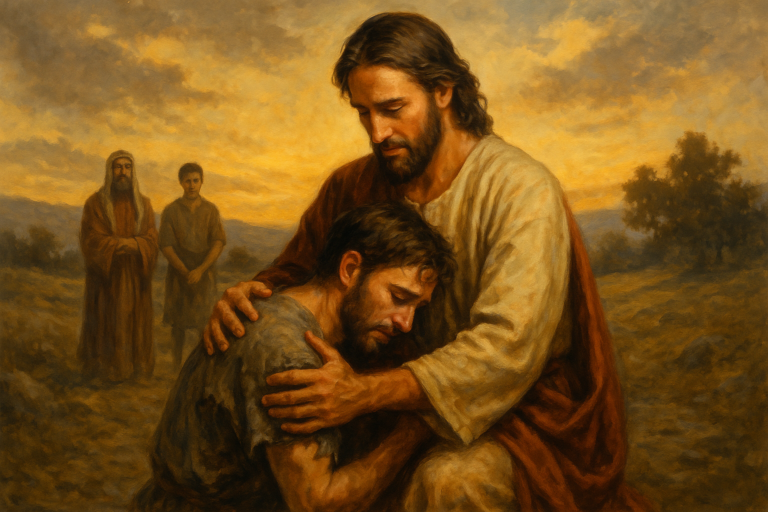
“To open their eyes, in order to turn them from darkness to light, and from the power of Satan to God, that they may receive forgiveness of sins and an inheritance among those who are sanctified by faith in Me.” Acts 26:18, NKJV. This is part of Paul’s defense before King Agrippa, in which he describes his calling by God to preach the gospel to the Gentiles. The message included repentance, which is a turning from the darkness of sin to the light of God, which is righteousness. That, together with faith, is needed so that sins might be forgiven.
“But shewed first unto them of Damascus, and at Jerusalem, and throughout all the coasts of Judaea, and then to the Gentiles, that they should repent and turn to God, and do works meet for repentance”. Acts 26:20, KJV. What are the works meet for repentance? Those are deeds, actions, behaviors, and motives that are consistent with true repentance from sin. Living in sin is inconsistent with true repentance. Living in sin is a flat-out contradiction to both repentance and faith.
“Testifying to Jews, and also to Greeks, repentance toward God and faith toward our Lord Jesus Christ”. Acts 20:21, NKJV. Paul’s message of salvation is consistent in that both repentance from sin and faith toward God must be part of it.
The Biblical Characteristics of true repentance, as taught by early church and Apostles, stated in 2 Corinthians 7:10-11, “For godly sorrow produces repentance leading to salvation, not to be regretted; but the sorrow of the world produces death. For observe this very thing, that you sorrowed in a godly manner: What diligence it produced in you, what clearing of yourselves, what indignation, what fear, what vehement desire, what zeal, what vindication! In all things you proved yourselves to be clear in this matter.”
What is the Baptism of Repentance?
What is the Baptism of Repentance, and why is it undeniably connected with the forgiveness of sins? It began with John the Baptist, whom Christ Himself called the ‘Greatest’ of all preachers.
“He went into all the country around the Jordan, preaching a baptism of repentance for the forgiveness of sins”. Luke 3:3
“And so John came, baptizing in the desert region and preaching a baptism of repentance for the forgiveness of sins.” Mark 1:4
In this process of repentance and faith unto salvation, the Old Man dies with Christ, is nailed to the cross, and is buried with Jesus. The New Man comes to life with the death of the Old Man. The Blood of the Covenant is applied to the Living Sacrifice, and that living sacrifice is the new Christian. Sin is purged from the conscience because sin is forsaken. The New and Living Way into God’s Kingdom is opened to the believer. See these versus Romans 6:4-6, Colossians 1:14, 2:11-15, 2 Corinthians 5:17, Hebrews 10:19-20.
Sin Stops After this Baptism of Repentance
“Therefore, since Christ suffered for us in the flesh, arm yourselves also with the same mind, for he who has suffered in the flesh has ceased from sin, that he no longer should live the rest of his time in the flesh for the lusts of men, but for the will of God”. 1 Peter 4:1-2
Sin is not merely covered, but is removed and washed away. “In ALL things you proved yourself to be Clear (PURE) in this matter!”, emphasis added, 2 Corinthians 7:11. No bondage to sins remains. We have victory over the world, the flesh, and the devil. The heart is set free in Christ. John 8:32 reads, “Then you will know the truth and the truth will make you free.” The context clearly means that we are set free from the slavery of sin.
New Christians partake of Christ’s sacrifice on the cross by sharing in His death, “So when we were baptized, we were buried with Christ and shared his death. We were buried with him so that we could live a new life, just as Christ was raised from death by the wonderful power of the Father. Christ died, and we have been joined with Christ by dying too. So we will also be joined with him by rising from death as he did. We know that our old life died with Christ on the cross. This was so that our sinful selves would have no power over us, and we would not be slaves to sin.” Romans 6:4-6. Is this not clear? The old sinful man or woman willingly dies with Christ and is raised as was Christ to a new life of righteousness. The power of sin and death is broken when we crucify the old sinful man and put him to death.
There is nothing in all this that suggests that the accomplishments of Jesus and His perfect obedience are transferred to you by fictional imputation. Fictional imputation is what the evangelical church, to a large extent, teaches. You are forgiven by dying with Him to the ways of the old sinful man. It is not Jesus dying in your place, but you dying to sin as He died for sin. Jesus became our sin offering. He did not become literally sin for us because He is sinless. (More on this subject as we look into the various atonement theories). We live a new life, one that follows the example Jesus set for us.
“For to this you were called, because Christ also suffered for us, leaving us an example, that you should follow His steps”, NKJV 1 Peter 2:21.
“Who his own self bare our sins in his own body on the tree, that we, being dead to sins, should live unto righteousness: by whose stripes ye were healed.” KJV, 1 Peter 2:24. How does it get any clearer that we, in our new life, are dead to sin and alive to righteousness? If this is not the case in your life, is it possible that you have not yet repented and believed the truth?
“For if the blood of bulls and goats and the ashes of a heifer, sprinkling the unclean, sanctifies for the purifying of the flesh, how much more shall the blood of Christ, who through the eternal Spirit offered Himself without spot to God, cleanse your conscience from dead works to serve the living God?” NKJV Hebrews 9:13-14. What are those dead works we are cleansed of? Everything that does not follow true repentance from sin.
Remember that you were bought with a price, which is the precious blood of Jesus Christ (1 Peter 1:18-19). You are redeemed from the dominion and slavery of sin by the blood of the Lamb. Now you are debtors to the Spirit, not the flesh, Romans 8:12. That’s why those who belong to Christ have already, once for all and not to be repeated, crucified the flesh with its passions and desires, Galatians 5:24. The old man is dead and buried with Christ. If you resurrect the old man, you crucify the Son of God afresh, see Hebrews 6 and 9, and put Him to open shame. As a result, you will fall into condemnation and spiritual death, Hebrews 10:26-31.
“For if you live according to the flesh you will die; but if by the Spirit you put to death the deeds of the body, you will live” NKJV, Romans 8:13. Living according to the lust of the flesh is resurrecting the old man or woman. The purpose of Christ’s death is to provide a way to kill the Old Man of sin, once for all, and to strip him of his advantage, Colossians 2:15. This can only happen by and through the Baptism of Repentance. The Christian growth process (sanctification) is not the process of sinning less and less over the course of our lives, but never stopping sin, but like the newborn baby in Christ desiring the true milk of the Word that he may increase thereby, 1 Peter 2:2.
God did not back then, nor does He today, grant forgiveness to man ‘in his sin’. God demonstrated His love toward mankind by sending Christ to die while we were still sinners, see Romans 5:8. God is not ‘passing over’ our sins, but ‘washing them away’ in ‘repentance and regeneration.’ The soul is scrubbed clean of defilement, ignorance, lust, and iniquity. And then the Holy Ghost can take up His abode in a clean temple, not a divided heart.
The conditions of salvation are “REPENTANCE and FAITH, see Acts 20:21. True repentance will always be validated and proven by deeds and a faith working by love, see Acts 26:20, Galatians 5:6. Sin is not a ‘symptom’ or ‘disease.’ Sin is a high crime against God. Repentance was granted by God precisely for the purpose of cleaning you up in that process of crucifying your flesh, putting to death your passions and desires which are contrary to the will of God. God is not willing to save you in your sins, but God is willing to save you from your sins. That is why repentance is absolutely necessary, as is faith.
Faith
We have already covered this subject in detail in other articles. See my article titled “Believe and be Saved Parts 1 and 2.” The point to remember is that saving faith will always produce repentance from sin. And in that way, it is true that if you genuinely believe, you are saved. But it is not true that repentance from sin is optional when you ‘believe’. The common evangelical concept of faith today is often characterized as a faith without faithfulness. Most Christians do not seem to understand that saving faith is not like the faith of the devils. Saving faith is an obedient and faithful faith. Saving faith without obedience is dead. Saving faith without works is dead and will not save anyone.
This is what the modern evangelical church teaches:
- You are born a sinner with a sinful nature that you will never be rid of even when you come to Christ.
- God had to punish Jesus to appease His wrath or to satisfy His retributive justice against sinful man.
- God is now made willing to save us as if He weren’t already.
- Jesus lived a sinless, perfect life, fulfilling all the righteousness required by the law of God, so that God can now apply the obedience of Christ to us. God now sees, not our ongoing disobedience, but the perfect obedience of Jesus Christ,
- If we trust in or have faith/believe this fictional imputation of Christ’s righteousness and the transfer of His obedience to us and our guilt to Jesus, we are saved eternally even if we never repent of any sins.
And the result of this belief system has led to:
- The death of Biblical repentance and faith. You become a follower of Christ in your sin.
- You can’t choose to stop sinning. You do not have the ability to stop sinning, even with the power of the Holy Ghost.
- God saves you in your ongoing sins. Then God begins to clean you up gradually over time. But the clean-up process will never be complete during this lifetime. And it will never be to the extent that sin in your life is the exception and not the rule. You will always remain a slave to sin until you die.
To take advantage of this religious scheme usually involves a simple prayer of confession that you are sinful and need a Savior. Trust in this scheme is necessary for salvation. Through this, you supposedly get the benefit of Jesus’s death on the cross to cover your sins. His example was lived out, not for you to ‘Follow in His Steps’, but so that God could TRANSFER/IMPUTE Christ’s obedience to you, making you fit for the Kingdom in your sinful state. This is the fiction of Double Imputation: Jesus is imputed to be a sinner/guilty, and we are imputed to be holy/innocent. Christ becomes our sins, and we become His sinlessness. There is no Biblical repentance or faith in this religious scheme devised by man.
