
July 14, 2023
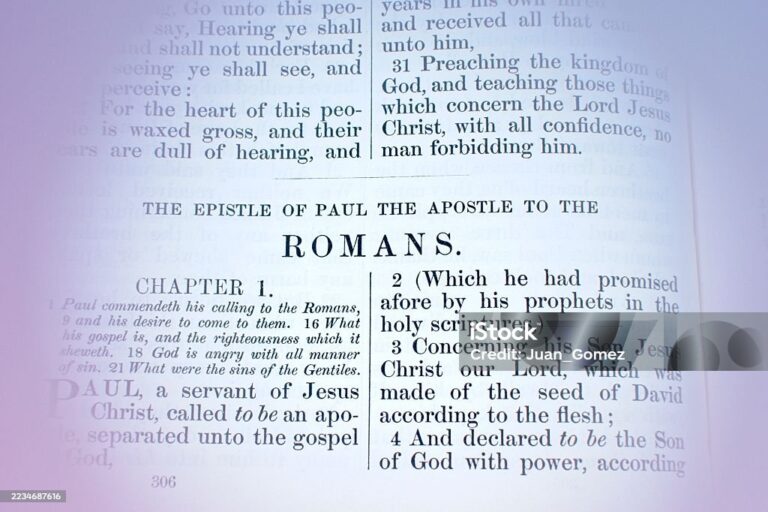
“For we know that the law is spiritual: but I am carnal, sold under sin. For that which I do I allow not: for what I would, that do I not; but what I hate, that do I. If then I do not that which I would not, I consent unto the law that it is good. Now then it is no more I that do it, but sin that dwelleth in me. For I know that in me (that is, in my flesh,) dwelleth no good thing: for to will is present with me; but how to perform that which is good I find not. For the good that I would I do not: but the evil which I would not, that I do. Now if I do that I would not, it is no more I that do it, but sin that dwelleth in me. I find then a law, that, when I would do good, evil is present with me. For I delight in the law of God after the inward man: But I see another law in my members warring against the law of my mind, and bringing me into captivity to the law of sin which is in my members. O wretched man that I am! Who shall deliver me from the body of this death? I thank God through Jesus Christ our Lord. So then with the mind I myself serve the law of God; but with the flesh the law of sin.” Romans 7:14-25
Of all the passages of the Bible that are used to justify ongoing sin in the life of a believer, this section is undoubtedly the one used most often. It is said that this was written by the Apostle Paul, describing his own life as a believer in Jesus Christ. In this passage, Saint Paul says that the good that he would do, he doesn’t do, and the evil that he shouldn’t do, he does. Paul cries out, O wretched man that I am, who will deliver me from the body of this death? Clearly, Paul is saying that he is not victorious over sin but fails constantly. His sin is habitual. It is his master, not God.
This is how many Christian pastors and teachers explain this passage of scripture. Almost every Christian church and evangelical leader that I am aware of teaches this interpretation of Romans 7. And nearly every Christian believes it is true. Moreover, they live just exactly like it is described in the seventh chapter of Romans. They are constantly doing what they shouldn’t do, and habitually not doing what they should do. Before you adopt this false and fatal interpretation, let us think about it some more. Let me present the case for a different interpretation.
Romans Chapter 7 has ended, and the first part of Chapter 8 tells us a much different story. The following verses of scripture are, “There is now no condemnation to them which are in Christ Jesus, who walk not after the flesh, but after the Spirit, for the law of the Spirit of life in Christ Jesus hath made me free from the law of sin and death. For what the law could not do, in that it was weak through the flesh, God sending his own Son in the likeness of sinful flesh, and for sin, condemned sin in the flesh: That the righteousness of the law might be fulfilled in us, who walk not after the flesh, but after the Spirit. For they are after the flesh do mind the things of the flesh; but they that are under the Spirit the things of the Spirit. For to be carnally minded is death; but to be spiritually minded is life and peace. Because the carnal mind is enmity against God: for it is not subject to the law of God, neither indeed can be. So then they that are in the flesh cannot please God. But ye are not in the flesh, but in the Spirit, if so be that the Spirit of God dwell in you. Now if any man have not the Spirit of Christ, he is none of his.” Romans 8:1-9, emphasis added.
Please remember that God does not inspire the system for numbering chapters and verses. Dividing chapter 7 from the first part of chapter 8 can give the erroneous impression that this is a new subject matter being discussed, which it is not. Paul is explaining the meaning of his earlier comments. These passages must be read together (the end of chapter 7 and the beginning of chapter 8). That is the proper context, and the man-made chapter divisions are sometimes not helpful.
In this passage above, Paul is telling his Christian readers that they are not in the flesh but in the Spirit. Paul says that there is no condemnation in Christ Jesus, because in Christ, we walk not after the flesh (indulging the sinful lusts of the body of flesh) but after the Spirit. In doing so, the righteousness of law is fulfilled in us. As long as believers abide in Christ, they will not fulfill the lusts of the flesh, which are sinful. They will fulfill the righteousness of law by the Spirit of Christ. Paul adds the following to ensure he is understood.
“Therefore, brethren, we are debtors, not to the flesh, to live after the flesh. For if ye live after the flesh, ye shall die: but if ye through the Spirit do mortify the deeds of the body, ye shall live. For as many are led by the Spirit of God, they are the sons of God.” Romans 8:12-14, emphasis added.
If you, as a Christian, live after the flesh, you will die in your sins. But if you mortify the sinful deeds of the body by the Spirit of God, you will live. Only those who the Spirit of God leads are sons of God. I do not know how it could be made any clearer. If you live “after the flesh”, you may think of yourself as a child of God, but you are not. You are deceived, according to Paul.
If you compare this section in Romans chapter 7:14-25 with chapter 8:1-14, the interpretation of Romans chapter 7 is much different. Paul is not contradicting himself in these passages. He is not saying that he or any genuine Christian does the evil he doesn’t want to do and doesn’t do the good that he should do, as a regenerate man of God. In chapter 8, he dispels that notion most clearly and definitely. In his own words, he rejects that interpretation. So, what in heaven’s name is Paul saying in Romans Chapter 7? We will come back to this in a moment, but first, let us consider the greater context, which includes the chapter preceding chapter 7.
Let us look at Romans Chapter 6, to see if that might help us understand what Paul is saying in chapters 7 and 8.
“What shall we say then? Shall we continue in sin, that grace might abound? God forbid. How shall we, that are dead to sin, live any longer therein?
“Therefore we are buried with him by baptism into death: that like as Christ was raised up from the dead by the glory of the Father, even so we also should walk in newness of life. For if we have been planted together in the likeness of his death, we shall be also in the likeness of his resurrection: Knowing this, that the body of sin might be destroyed, that henceforth we should not serve sin. For he that is dead is freed from sin.” Romans 6:1-2, 4-7 emphasis added.
How does it get any clearer? How shall we, that are dead to sin, live any longer in sin? We can’t. It makes no sense to be “dead to sin” and “alive to sin” at the same time. Those in Christ Jesus no longer serve sin; they are “dead to sin”.
“Likewise reckon ye also yourselves to be dead indeed unto sin, but alive to God through Jesus Christ our Lord. Let not sin therefore reign in your mortal body, that ye should obey it in the lusts thereof. Neither yield ye your members as instruments of unrighteousness unto sin: but yield yourselves unto God, as those that are alive from the dead, and your members as instruments of righteousness unto God. For sin shall not have dominion over you: for ye are not under the law, but under grace. What then? Shall we sin, because we are not under the law, but under grace? God forbid.” Romans 6:11-15 emphasis added.
Christians are not under the dominion of sin. We are to reckon or consider ourselves dead to the practice of sin. We are no longer slaves of sin. We are to yield ourselves as instruments of righteousness, not of sin, because we are under the grace of God. But just because we are under God’s grace, it doesn’t mean that we can sin with impunity. God forbid such a wicked interpretation. But isn’t that precisely what the typical interpretation of Romans 7 allows for? It is.
“Know ye not, that to whom ye yield yourselves servants to obey, his servants ye are to whom ye obey, whether of sin unto death, or of obedience unto righteousness. But God be thanked, that ye were the servants of sin, but ye have obeyed from the heart that form of doctrine which was delivered you. Being made free from sin, ye became the servants of righteousness…….even so now yield your members servants to righteousness unto holiness…..But now being made free from sin, and become servants to God, ye have your fruit unto holiness, and the end everlasting life. For the wages of sin is death: but the gift of God is eternal life through Jesus Christ.” Romans 6:16-23 emphasis added.
If Christians obey the sinful lusts of the flesh, they will die. Real Christians are free from sin: “ye became servants of righteousness unto holiness.” We are reminded that those who are in Jesus Christ and no longer servants of sin but servants of righteousness, the outcome is everlasting life. But to those who live in sin, the wages of sin are eternal death, even if you call yourself a Christian.
In chapters 6 and 8 of Romans, the Bible talks about a believer’s victory over sin and the lusts of the flesh, not the believer’s continuation in sin, as a slave of sin. In chapter 7, Paul says that he is a slave of sin and held in bondage to the lusts of the flesh. The evil he would not do, he does, and the good that he should do, he doesn’t do. In the space of a few paragraphs (from chapter 6 through chapter 8), is the great and godly Apostle Paul contradicting himself? May it never be.
If you then compare the book of Romans to other New Testament Books, an honest and candid mind will easily determine that these books uniformly describe a believer’s victory over sin, the flesh, and the devil. Take, for example, 1 John.
“And hereby we do know that we know him, if we keep his commandments. He that saith, I know him, and keepeth not his commandments, is a liar, and the truth is not in him……He that saith he abideth in him ought himself also so to walk, even as he walked.” 1 John 2:3-6
Many Christians claim to know God but do not keep His commandments. The Bible says they are liars. These so-called Christians never expect to habitually and consistently keep His commandments. They often look to Romans 7 for relief from that burden to “walk the talk”. They are deceiving themselves, “he that saith he abideth in him ought himself also so to walk, even as he walked”.
“If ye know that he is righteous, ye know that everyone which doeth righteousness is born of him.” 1 John 2:29
Many Christians claim to be born of Him, yet they do not practice righteousness. They admittedly practice sin and believe they are like Paul in Romans Chapter 7. Paul was living in sin, so why would anyone expect to live a better life than Paul? “Men prefer to believe what men prefer to be true.” Not what is true, but what they want to be true. Christians and non-Christians alike believe what makes them feel better about themselves, even if it will cost them eternal life. Those who do not “doeth righteousness” are not born of God, according to this inspired writer.
“Whosoever abideth in him sinneth not: whosoever sinneth hath not seen him, neither known him. Little children, let no man deceive you: he that doeth righteousness is righteous, even as he is righteous. He that committeth sin is of the devil; for the devil sinneth from the beginning. For this purpose, the Son of God was manifested, that he might destroy the works of the devil. Whosoever is born of God doth not commit sin; for his seed remaineth in him: and he cannot sin, because he is born of God.” 1 John 3:6-9
Abiding in Jesus Christ means that you do not continue to practice sin. Sin is the exception in your life and not the rule. The person who sins is not born of God. If they were born of God, they would cease from the practice of sin. As long as our purpose in life is to please God, we can’t sin. If we change our purpose in life from God pleasing to self-pleasing, we have sinned. But as long as we love God with all our heart, soul, mind, and strength, sinning is impossible. Sinning is inevitable if we start to love ourselves supremely.
“For this is the love of God, that we keep his commandments: and his commandments are not grievous. For whatsoever is born of God overcometh the world: and this is the victory that overcometh the world, even our faith.” 1 John 5:3,4.
John makes it clear that if we love God, we will obey His commandments from the heart, as the commandments are not burdensome or grievous to those who love God. Those people find delight in obeying God and doing His will. How many Christians today can even comprehend that last sentence about taking delight in obeying God and doing His will? Based on what most of us have been taught in church, that is a foreign concept.
Everyone who loves God overcomes the world, the world of sin. Not that they might someday overcome the world, but that they in fact overcome the world right now. What great news is that. Our faith, in Jesus Christ, will give us the victory every time.
“We know that whosoever is born of God sinneth not: but he that is begotten of God keepeth himself, and that the wicked one toucheth him not.” 1 John 5:18
Just in case we still don’t get it, the Apostle John tells us once again that “whosoever is born of God sinneth not.” Those are not my words. They are John’s words. These are the actual words from God Almighty. I recommend that we listen and obey.
In other words, whoever is born of God does not live in a Romans 7 experience. Life in Romans chapter 7 is when the lusts of the flesh rule our lives and we sin habitually. Do you think that John is saying something vastly different than what Paul wrote in the book of Romans, chapters 6, 7, and 8? Not on your life.
Final thoughts
I could go on and on listing verses of the New Testament that say the same thing. Paul, in his letters to the Corinthians, Galatians, and Ephesians, told everyone not to be deceived; the unrighteous will not inherit the kingdom of God or the kingdom of Christ. Yet how many, even today, are fooled into believing that a Romans 7 experience is what God is looking for in us. Their deception runs so deep that they think that God must be well pleased with their sinful and unrighteous lifestyle.
What was Paul saying in Romans 7?
We are now ready to address what Paul was saying in Romans Chapter 7. Paul, if he was describing his own experience or the experience of someone else, is not the real issue. Paul is describing the internal conflict in a person who is trying to be religious or spiritual without being born again or regenerated. He was most likely talking about what goes on in an awakened and convicted sinner’s mind and heart before that person repents and believes in the gospel. This is the experience of someone who is convicted of sin, struggling, and yet undecided and uncommitted in giving their whole being and all that they have to God. To be one of His children requires everything from us. Many religiously minded people try to be good, without the heart of a good person. That is what life looks like in Romans 7: always doing what they know is wrong or not doing what they know must be done. There is nothing but condemnation in that state, Romans 7. Praise God, as Paul expressed it in Romans 8:1, “There is therefore now no condemnation to them that are in Christ Jesus, who walk not after the flesh, but after the Spirit.”
If you want to know what the life of a child of God looks like, do not use Romans 7. Instead, use Romans chapters 6 and 8, the book of 1 John, and these chapters, 1 Corinthians 6, Ephesians 5, and Galatians 5, to mention a few passages that make it as clear as it can be made. The unrighteous will not inherit the kingdom of Christ. The unrighteous are those who practice unrighteousness, those who live in sin. All of these lost souls will inherit hell.
Using Romans chapter 7 to define a Christian’s actual walk is precisely what one would expect in the last days apostasy of the church. Using this chapter (Romans 7) to define Christian experience has significantly contributed to the moral bankruptcy of our culture and our nation.
“There is therefore now no condemnation to them that are in Christ Jesus, who walk not after the flesh, but after the Spirit.” Romans 8:1. This is the power of the truth and the gospel of Jesus Christ. Romans 7 does not describe this truth.
Postscript
May 17, 2025
In this article, I did not address what the early church, before Augustine in the 5th century, believed regarding this passage in Romans 7. The following is taken from a book written by David Bercot, The Historic Faith Commentary Series, Romans: How Romans was understood before Augustine and Luther, published by Scroll Publishing Co., Amberson, Pa. 17210.
Mr. Bercot agrees that modern Christianity, for the most part, has mistakenly misunderstood what the apostle Paul was saying in Romans 7:14-25. “However, to the early Christians, it was clear that in this passage, Paul is using the literary device known as impersonation. That is, he is taking on the role of someone else. In this instance, he is portraying someone trying to find freedom from sin through the Law. Paul is portraying what life is like for such a person, whom he ends up designating as a “wretched man.” Page 187, emphasis added.
Paul is not talking about himself and his experience, even though it may appear to be the case. Paul is taking on the role of a person in a much different position and applying it to himself. Suppose he was talking about himself in Romans 7. How could Paul, in honesty, tell the Corinthians to “be imitators of me even as I also of Christ”, 1 Corinthians 11:1. There are other passages that tell us the same thing. The following list of early church fathers all agree with this interpretation and not Augustine’s later interpretation (his initial interpretation agreed) or Luther’s or the main body of evangelicals today.
- Chrysostom 347-407
- Theodoret 390-460
- Origen 185-234
- Constantius 396-405
- Cyril of Jerusalem 313/5-386
- Methodius of Olympus died in 311 AD
- Augustine 354-430, early writings, but changed in his controversy with Pelagius.
This controversy between Augustine and Pelagius led Augustine to change his views on critical Christian doctrines. (He reverted back to many of his prior pagan doctrines.) It led him to believe that Paul wrote this passage in Romans 7 about himself because it fit his doctrine of total depravity, total inability, which came from his belief in the dogma of Original Sin. Centuries later, the reformers (Luther, Calvin, and most others who followed them) took up Augustine’s new position on Romans 7 and fundamental Christian doctrines.
Other Christian theologians have steadfastly maintained early Christian beliefs about this passage and rejected Augustine’s latest interpretation. One example is the Methodist commentator, Adam Clarke. Mr. Bercot uses this quote from Adam Clarke (1762-1832), “It is difficult to conceive how the opinion could have crept into the Church, or prevailed there, that the apostle speaks here of his regenerate state; and that what was, in such a state, true of himself, must be true of all others in the same state. This opinion has, most pitifully and most shamefully, not only lowered the standard of Christianity, but destroyed its influence and disgraced its character. It requires but little knowledge of the spirit of the gospel, and the scope of this epistle, to see that the apostle is here impersonating a Jew under the Law and without the gospel.” Page 190, emphasis added.
I included this information to underscore what is being taught in this passage, and it is not what most brain-washed Christians believe. The apostle Paul lived in victory over the world, the flesh, and the devil. Paul did not live in the slavery of sin and told his readers that they too must live victorious lives like himself. Evangelical Christianity today is far removed from this proper interpretation of Romans 7 and the gospel of Jesus Christ. The gospel is that Jesus came to save His people from their sins, not in their sins. Matthew 1:21.
