
February 5, 2026.
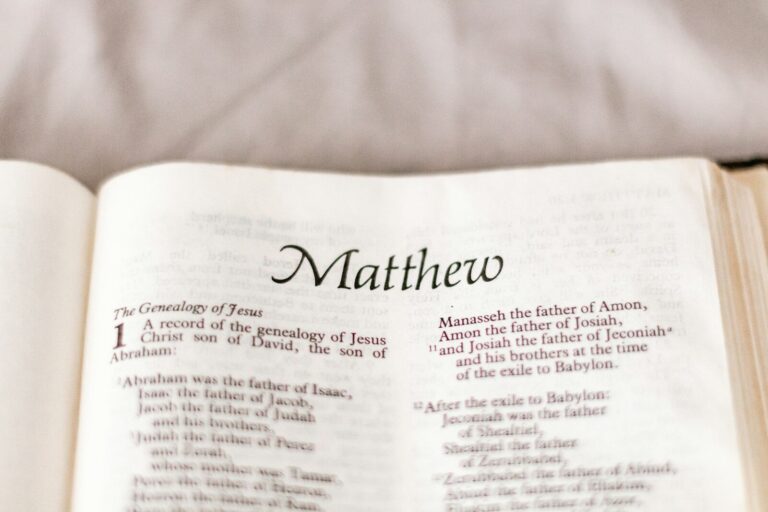
Matthew 1 is doing a lot of theological work. Let’s take it in two movements:
(1) the three sets of fourteen generations, and then
(2) Matthew 1:21 and how the early church understood “he shall save his people from their sins.”
1. The significance of the three sets of fourteen generations (Matt 1:1-17)
A. Why “fourteen” at all?
The early church almost universally saw this as intentional, symbolic, and theological, not accidental chronology.
1. Davidic symbolism (the dominant patristic (early church) view)
In Hebrew gematria (letters have numerical value):
- David (דוד)
- Dalet (4) + Vav (6) + Dalet (4) = 14
Fourteen = David.
What Matthew is saying: Jesus is the Davidic Messiah, and all of Israel’s history is being structured around David and fulfilled in Christ.
Church Fathers
- Jerome explicitly notes the numerical value of David’s name.
- Augustine affirms the symbolic ordering rather than strict biological completeness.
- Eusebius emphasizes Matthew’s concern with royal lineage, not mere ancestry.
This is why Matthew opens with: “Jesus Christ, the son of David, the son of Abraham” (Matt 1:1). Not Moses. Not Adam. David first.
2. Salvation history in three epochs
The early church Fathers also saw a three-act drama:
- Abraham to David. Promise rising
- David to the Exile. Kingdom collapses
- Exile to Christ. Restoration fulfilled
Church Father Chrysostom:
Matthew arranges history to show that human kingship fails, but God’s promise does not. The exile into Babylon is the theological low point—and Christ appears after exile, not during Israel’s glory.
3. Deliberate omissions in the chronology (not a problem for the church Fathers)
Matthew intentionally omits several kings (e.g., Ahaziah, Joash, Amaziah). The early church was not troubled by this.
- Genealogies were allowed to be selective.
- The purpose was theological meaning, not census accuracy.
Augustine (Harmony of the Gospels): Matthew’s ordering is shaped “not by ignorance, but by design.” In other words, Matthew is preaching with numbers.
4. Six “sevens” and the arrival of the seventh
Some Fathers (especially later ones) noticed:
- 3 × 14 = 42 generations
- 42 = 6 × 7
Jesus arrives at the threshold of the seventh seven. Christ inaugurates Sabbath fulfillment: rest, completion, new creation. This ties directly to Matthew’s heavy Sabbath and kingdom theology later in the Gospel.
This is interesting, and now we move into what is most important and relevant in this first chapter.
2. Matthew 1:21. “He shall save his people from their sins.”
“And she shall bring forth a son, and thou shalt call his name JESUS: for he shall save his people from their sins.”
A. The name “Jesus” (Ἰησοῦς/Yeshua)
The Fathers are unanimous here:
- Jesus equals YHWH saves
- The name itself is a prophecy
Jerome wrote that the name reveals the work before the work is done. This is not merely deliverance by God; it is God himself acting.
B. “Save his people,” but who are “his people”?
Here’s where early Christian interpretation is strikingly consistent and often anti-nationalistic.
1. Not merely ethnic Israel
The Fathers insist:
- “His people” begins with Israel
- But expands to all who believe, including the Gentiles
Justin Martyr: We who believe are the true Israel, saved by the same Christ.
Irenaeus: He gathers the scattered children of God into one.
Matthew himself supports this later (Matt 8:11; 28:19).
C. “From their sins”, not from Rome
This is one of the most emphasized points in early Christian preaching.
The angel does not say Christ came to save his people:
- from Rome
- from political oppression
- from exile
- from suffering or persecution
- from just the penalty of sin
But:
- from their sins.
The patristic, or early Church, consensus holds that this is moral, ontological, and spiritual salvation, not merely legal justification.
Chrysostom: He did not say “from their punishment,” but “from their sins.” The root of sin is itself removed.
Athanasius: Sin leads to corruption and death; Christ heals the corruption itself.
This is the ultimate transformative salvation, not merely forensic acquittal as many evangelicals today actually think. Slaves of sin are freed in Christ and no longer serve sin but have become slaves of righteousness.
D. How this connects to later theology debates
This verse becomes a quiet fault line later in Christian history.
Early church emphasis:
- Sin as bondage and slavery
- Salvation as healing, purification, liberation
- Christ saves by uniting humanity to God
Much later Western emphasis (post-Augustine, intensified in the Reformation):
- Sin as guilt
- Salvation as a legal justification or acquittal = not guilty, as it is believed by many today
- “Save from sins” becomes primarily judicial rather than transformative (new creation in Christ, the old man is crucified)
The Fathers would not deny forgiveness, but they would say: Forgiveness without deliverance from sin or transformation is incomplete salvation. An incomplete salvation is not salvation at all. If a person is not saved from sinning, then they are not saved at all.
Pulling it together
Matthew 1 is doing theology, not bookkeeping:
- The genealogy proclaims:
- Jesus is the true David
- Israel’s history finds completion in him
- Human failure does not cancel this divine promise
- Matthew 1:21 proclaims:
- Jesus is God’s saving presence
- His mission is deeper than politics
- Salvation means real deliverance from sin itself, from the slavery of sin, which is the liberty of living righteously
Next, we will do the following:
- Trace how “save us from our sins” gets reframed in Augustine and later Protestant theology
- And connect Matthew 1 directly to Romans 8 and Hebrews (which we have already been circling)
Let us begin here;
- How the early church understood “save us from our sins.”
- How Augustine reframed it
- How the Reformers (and later Protestantism) received and sharpened Augustine.
1. The pre-Augustinian, patristic understanding
(“Save from sins” equals liberation plus healing plus participation)
For the first three centuries, and thereafter really dominant in the East, “save from our sins” meant deliverance from the power, practice, and corruption of sin. Today, to many evangelicals including Calvinists, it basically means salvation from guilt and the penalty of sin. It most definitely doesn’t mean deliverance from the commission of sins, for they believe Christians will always continue to sin, even daily.
A. Sin as bondage and disease
The Fathers overwhelmingly describe sin as:
- Enslavement (John 8:34)
- Illness needing healing
- Corruption leading to death
That doesn’t mean the Eastern Orthodox believe that sin is involuntary, as a sickness can be contracted involuntarily. Sin is a crime against God, not a sickness.
Irenaeus: Christ became what we are, that we might become what He is.
Athanasius: Humanity was sliding back into non-being; the Word restores it.
Salvation is ontological: something real changes in the person. If any man be in Christ, he is a new creation, old things are passed away, and all things become new, so says the Word of God.
B. Forgiveness exists, but it’s not the center, as is salvation from the power of sin itself
Forgiveness is assumed, but it’s instrumental, not the goal. The goal is:
- purification
- restoration of the image of God
- victory over sin
“Saved from sins” means: You are no longer ruled by them, and you have stopped committing them. This fits Matthew 1:21 very naturally.
2. Augustine’s reframing (4th-5th century)
Augustine does not reject the earlier view directly, but he re-centers the problem, according to ChatGPT. That is code for saying that Augustine turned this early Christian understanding on its head so that it now means the opposite of what the early church fathers taught and believed. Augustine will tell the Christian church that Christ came to save us in, not from, our sins.
A. New starting point: assumed inherited guilt, which Augustine brought into Christian theology
Responding to Pelagius initially, Augustine develops:
- Original sin as transmitted guilt
- Humanity as a massa damnata (a condemned mass)
- Sin primarily as culpability before God
This major shift comes from Augustine’s strawman of Pelagius. For Pelagius denied almost everything Augustine attributed to him.
Before Augustine:
- Sin → corruption → death → bondage
With Augustine:
- Sin → guilt → condemnation → need for pardon/justification
B. “Save from sins” becomes primarily forensic with Augustine and not ontological (new man, new creation)
Augustine increasingly interprets salvation as God legally forgiving the sinner before moral healing, which comes slowly, but never totally, over the Christian’s life. He does believe in transformation, but it is:
- incomplete in this life; Christians sin daily
- never victorious over sin fully; Christians sin daily
- always mixed with ongoing guilt; Christians sin daily
This leads to a crucial error: Even the regenerate remains deeply sinful at all times. The early church fathers never believed that.
Is it any wonder that most Christians today believe they will sin daily for the rest of their lives and still go to heaven?
C. Romans 7 becomes central to Christian life
Augustine’s later reading of Romans 7 (“I do what I hate”) is pivotal. He interprets it as:
- the normal Christian life (early church fathers did not teach this)
- ongoing moral failure
- unavoidable daily sin
This reading becomes dominant in the West and is the cause of the ongoing moral corruption in our churches. Almost all evangelicals still believe this today. So “save from sins” cannot mean actual freedom from sin, because that is now thought impossible. It must mean, saved from the penalty and guilt of sins, including our future sins.
Matthew 1:21 now reads, “Jesus came to save us in our sins, not from them.”
3. The Protestant inheritance and intensification
The Reformers explicitly knew they were following Augustine, and said so.
A. Luther
Luther radicalizes Augustine’s anthropology.
- Simul iustus et peccator (simultaneously righteous and unrighteous, holy and unholy, good tree and bad tree.) What a fatal error this is.
- The believer is righteous by fictional imputation only
- Sin remains fully present in the believer, and believers sin daily
Thus, “Save from sins” equals saved from condemnation, not from sin itself. Saved not from the ongoing practice of sin but only from the penalty and guilt of sin. This reverses what the angel told Joseph and the rest of the world.
Sanctification becomes important, though it is questionable how important it actually is; it is never victorious in this life, according to Augustinian Calvinism. Its importance lies in enabling a smoother transition in Augustine’s rewrite of the angel’s promise.
B. Calvin
Calvin systematizes the Augustinian logic.
- All humanity is born sinful: total depravity and total inability (post-fall)
- Justification as a legal declaration of not guilty, which is false but sounds good
- Perseverance grounded in decree, not real transformation, not ceasing from sin
Calvin explicitly denies that Matthew 1:21 means freedom from sin in this life. What a great heresy that is, and how readily it is accepted in our day.
Salvation is:
- forensic first
- transformative second, but never successful in this life, for all Christians sin daily throughout their lives
- never complete until glorification
C. Reformation-era consensus
Across magisterial Protestantism:
- Sin remains in every thought, word, and deed
- Obedience is always imperfect and not truly obedience at all
- Assurance rests on Christ’s righteousness imputed to us, not on our actual victory over sin
The serpent couldn’t have created anything more diabolically effective. Thus, Matthew 1:21 is read as: He saves his people from the guilt and punishment of their sins, but not from the slavery of sin.
4. What was lost (and what was gained)
Gained:
- Strong assurance as long as you can believe the lies
- Clear emphasis on grace as God winking at our sins
- Serious recognition of human weakness, but when God decrees our weakness, how serious can it really be?
Lost:
- Expectation of real victory over sin in our lives
- Ontological healing is central and our only hope
- Matthew 1:21 as a present reality for those who have faith in Christ
The early church would ask: If Christ does not actually free us from sin, in what sense are we saved from it?
Final thought (not polemic, just historical)
The debate is not whether grace is necessary; everyone agrees that it is. The debate is what grace actually accomplishes. The early church heard Matthew 1:21 and thought: “He will actually free us from the slavery of sin.”
Much later, Western theology increasingly heard: “He will count us as free from the condemnation of sin, albeit we are not free from actual sinning in this life.” That difference explains many of the later disagreements.
Let us now consider the following:
- Show where Eastern Orthodoxy explicitly rejects Augustine
- Examine 1 John 3 vs. simul iustus et peccator
First bullet point. Where Eastern Orthodoxy explicitly rejects Augustine’s manipulation of the Word of God
The Orthodox Church does not treat Augustine as a normative father. The Orthodox Church respects him as a Western saint, but explicitly rejects his anthropology and doctrine of original sin. This is not modern revisionism; it’s stated in authoritative Orthodox teaching.
1. Augustine’s Original Sin: guilt vs. corruption
- Original sin equals inherited guilt
- Humanity is born condemned
- Sin is unavoidable even for the regenerate
- Will in bondage (a non-free, free will)
Eastern Orthodoxy
- Original sin equals inherited corruption and mortality
- No inherited guilt
- Sin is tragic, not juridical
- Our Will is still intact and is still free
Explicit Orthodox statements
Council of Jerusalem (1672) (authoritative in Orthodoxy):
We believe the baptized are freed from original sin… yet not from the consequences of corruption and death.
Notice:
- Freed from sin
- Not merely declared free
This council explicitly rejects the Augustinian doctrine of inherited guilt.
St. John Cassian (5th century, East → West bridge)
Augustine’s doctrine makes God the author of evil by necessity.
Cassian directly opposed Augustine during the Pelagian controversy and is fully received in Orthodoxy.
2. Total depravity and total inability are explicitly denied. This is the cornerstone of Calvinism.
Orthodoxy rejects the idea that human nature is totally corrupted.
St. John of Damascus. The image of God was darkened, not destroyed.
This contrasts with Augustine’s later anthropology and all Reformation developments stemming from it.
3. Sin in the regenerate: disagreement with Augustine
Augustine:
- Christians sin continuously
- Romans 7 describes the Christian life
Orthodoxy:
- Romans 7 describes life under the law, not life in Christ
- Romans 8 describes the Christian norm, victory over sin and the flesh
St. Gregory of Nyssa
The soul united to God does not sin, for darkness cannot coexist with light. This explicitly rejects Augustine’s reading.
4. Theosis vs. forensic justification
Orthodoxy does not merely prefer theosis; it sees it as the gospel itself.
St. Athanasius
God became man so that man might become god. Augustinian-Protestant frameworks have no place for this statement except metaphorically.
Second bullet point. 1 John 3. The fault line text
Let’s look at the text first (KJV): “Whosoever is born of God doth not commit sin; for his seed remaineth in him: and he cannot sin, because he is born of God.” (1 John 3:9)
The language is absolute. The Fathers did not soften it. Augustine refused to accept and believe it. Is that not the sin of unbelief?
1. Pre-Augustinian and Orthodox reading
Literal, moral, ontological. The Orthodox read this as:
- A real state of life
- A description of participation in divine life
- Sin is incompatible with abiding in Christ
St. Clement of Alexandria. The true Gnostic sins no more, for he lives in God.
St. Maximus the Confessor. When the mind is united to God, sinful desire ceases.
Sinlessness is not perfectionism; it is freedom from willful sin.
“Cannot sin” means what it says. The early church Fathers explain:
- Not that temptation disappears, for it doesn’t
- But that deliberate sin becomes impossible while abiding in God
When sin occurs, it is because one has ceased abiding. This fits: “Whosoever abideth in him sinneth not” (1 John 3:6)
2. Augustine’s reinterpretation of 1 John 3
Augustine knew the text contradicted his theology if read plainly and honestly. So what does he do? He reframes it, and he rewrites it.
Augustine’s move:
- “Does not sin” means does not sin unto death
- Or it means that sin is not a ruling habit, as if the daily sin that Augustine proposed is not a ruling habit. Who can honestly believe his explanation?
- Or it means that sin is present but not imputed; Jesus’ obedience is imputed or substituted for our disobedience. And our disobedience is imputed to sinless Jesus.
This is a semantic retreat and word game, not a grammatical necessity. Augustine explicitly admits the tension: If we say we have no sin, we deceive ourselves (1 John 1:8). So, he resolves or tries to resolve the tension in favor of Romans 7, not 1 John 3. This is a perfect example of what not to do as a seeker of the truth.
3. Orthodox resolution of the “contradiction.”
Orthodoxy resolves it differently:
1 John 1:8 Refers to:
- Those not yet fully purified
- Or is a warning against pride
- Or it addresses lapses outside of abiding
1 John 3 Describes:
- The state of abiding
- The telos of salvation
- What grace actually does
No contradiction, two states of life.
4. Protestant handling (Augustine intensified)
Protestantism follows Augustine almost uniformly:
- “Cannot sin” means cannot live in unrepentant sin (but actually Christians do live in unrepentant daily sin, which directly contradicts their false assertion)
- Or it refers only to positional righteousness (which is fictional and not real)
- Or it refers to a new nature abstracted from lived experience (but this new nature is also a slave of sin)
Thus, Augustine thought this verse was safe. But it is no longer allowed to describe real experience. It is a complete and totally false rewrite of God’s word.
Why does this matter for Matthew 1:21?
Now we close the loop. Matthew 1:21: “He shall save his people from their sins.”
Orthodox reading:
- Christ actually removes sin’s power so that believers have real victory over sin in their lives
- 1 John 3 describes the lived reality of that salvation
Augustinian-Protestant reading:
- Christ removes guilt only
- Habitual sin remains inevitable even for believers in Christ
- 1 John 3 must be reinterpreted so that it disagrees with the early church fathers
The Orthodox explicitly say: If Christ does not free us from sin, He has not saved us from sin.
Closing thought
This isn’t about East vs. West personalities. It’s about what we expect grace to do. It is also about what God demands of those who claim to love Him. It’s about what the gospel of good news is all about.
Is the good news of the gospel that Jesus saves us from the guilt of sin, even if we don’t stop that sin, or is the good news of the gospel that we are saved from the power and guilt of sin, conditioned on our confessing and forsaking of our sins?
Orthodoxy reads the New Testament and says God really changes people from sinners to saints.
Augustinian theology says that God really forgives people, but can’t or won’t change us and give us victory over sin in our present life.
Both affirm grace, but they mean different things by salvation.
